Resolving the Knowledge “Trade Deficit” Paradox and the Ambition to Position Vietnamese Universities
July 16, 2026


There are no shortcuts to rising in the rankings; the true status of a national higher education system can only be built on sustained internal strength and strategic synergy. This view achieved high consensus at the seminar “From Data to Global Status: Research, Sustainable Development, and the Presence of Vietnamese Universities on the World Map,” held on July 15 in Hanoi. The seminar was co-organized by Times Higher Education (THE) and VinUniversity.
The Knowledge “Trade Deficit” Gap
At the seminar, Ms. Pham Thanh Hao, Vice President of VinUniversity, shared her concerns regarding the severe imbalance in Vietnam’s educational import-export balance. The country’s “knowledge trade deficit” (net importer status) is incredibly heavy. Data from the OECD and international educational organizations estimate Vietnam’s study-abroad deficit ratio to be at 11:1. This means around 250,000 Vietnamese students are studying abroad, while the total number of international students coming to study in Vietnam is only about 20,000.
Meanwhile, neighboring Malaysia boasts a “knowledge trade surplus” of 2.5:1. They have about 55,000 students going abroad but manage to attract 130,000 international students, generating revenues of up to $1.8 billion USD annually. This gap between us and our neighbor stems from a massive difference in our capacity to attract global talent.
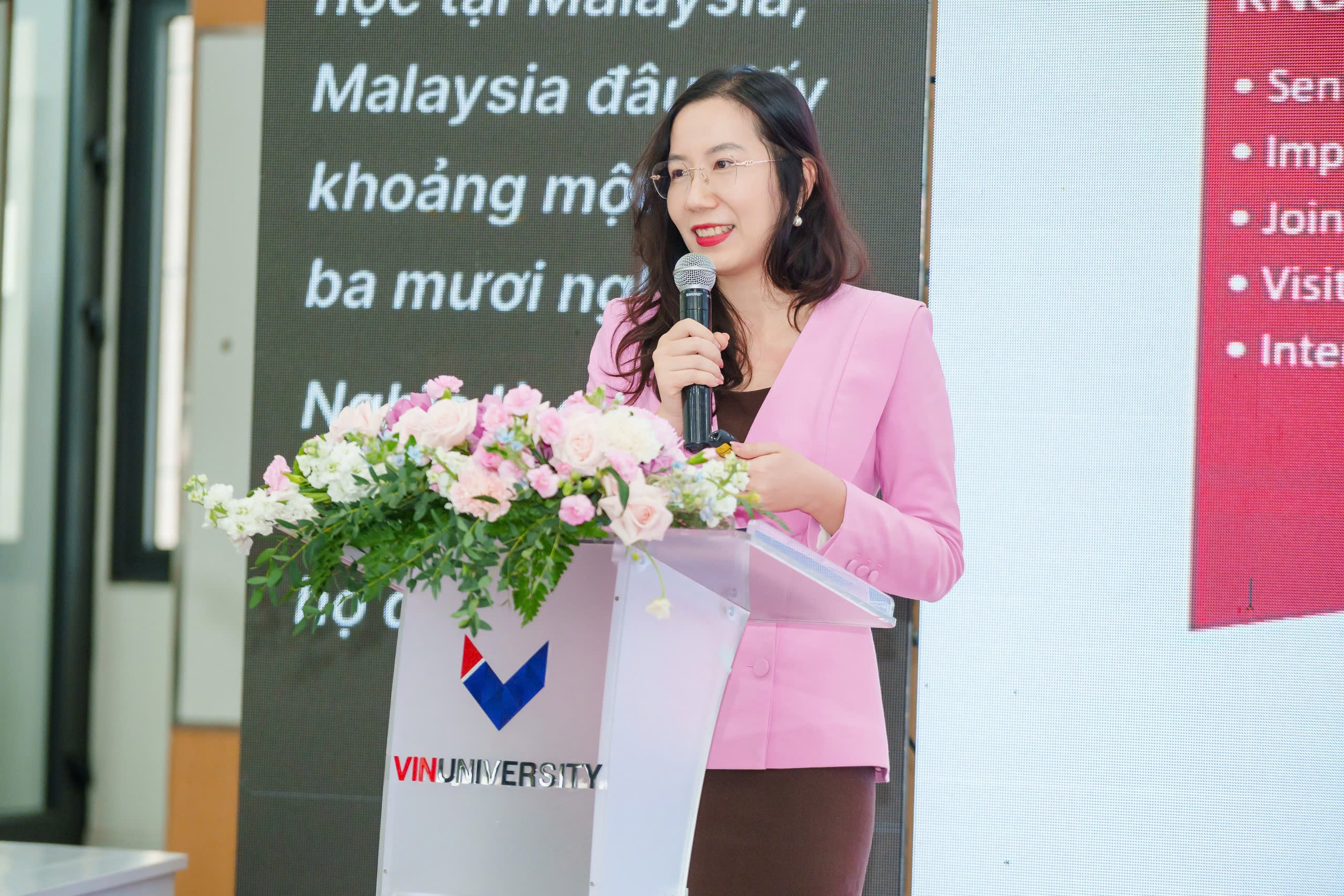
Ms. Pham Thanh Hao, Vice President of VinUniversity, presenting her paper titled “From Internationalization to Global Status.”
According to Ms. Hao, Vice President of VinUniversity, THE data shows that the average ratio of international faculty at Vietnamese universities on prestigious rankings sits at a modest 1.3%, while the international student ratio is 0.5%. In contrast, these figures in Malaysia are 16.6% and 22.9%, respectively; in Indonesia, 8.4% and 2.1%; and in Thailand, 4.4% and 1.9%. Even top public universities in Vietnam today, such as Vietnam National University, Hanoi, Hanoi University of Science and Technology, or Hanoi Medical University, record international student ratios on ranking datasets that are virtually 0%.
This massive gap is a major barrier preventing domestic universities from improving their “international outlook” index, which carries a 7.5% weight in the THE World University Rankings.
Ambitions and Pitfalls
The ambition to rise and position the national higher education brand is the hope for filling this knowledge deficit gap. According to Assoc. Prof. Nguyen Thu Thuy, Director General of the International Cooperation Department, MOET, Resolution No. 71-NQ/TW of the Politburo on breakthroughs in education and training development sets a clear goal: by 2030, Vietnam strives to have at least one higher education institution in the world’s top 100 in certain fields, at least eight institutions in Asia’s top 200, and to attract at least 2,000 talented foreign lecturers to work in the country.
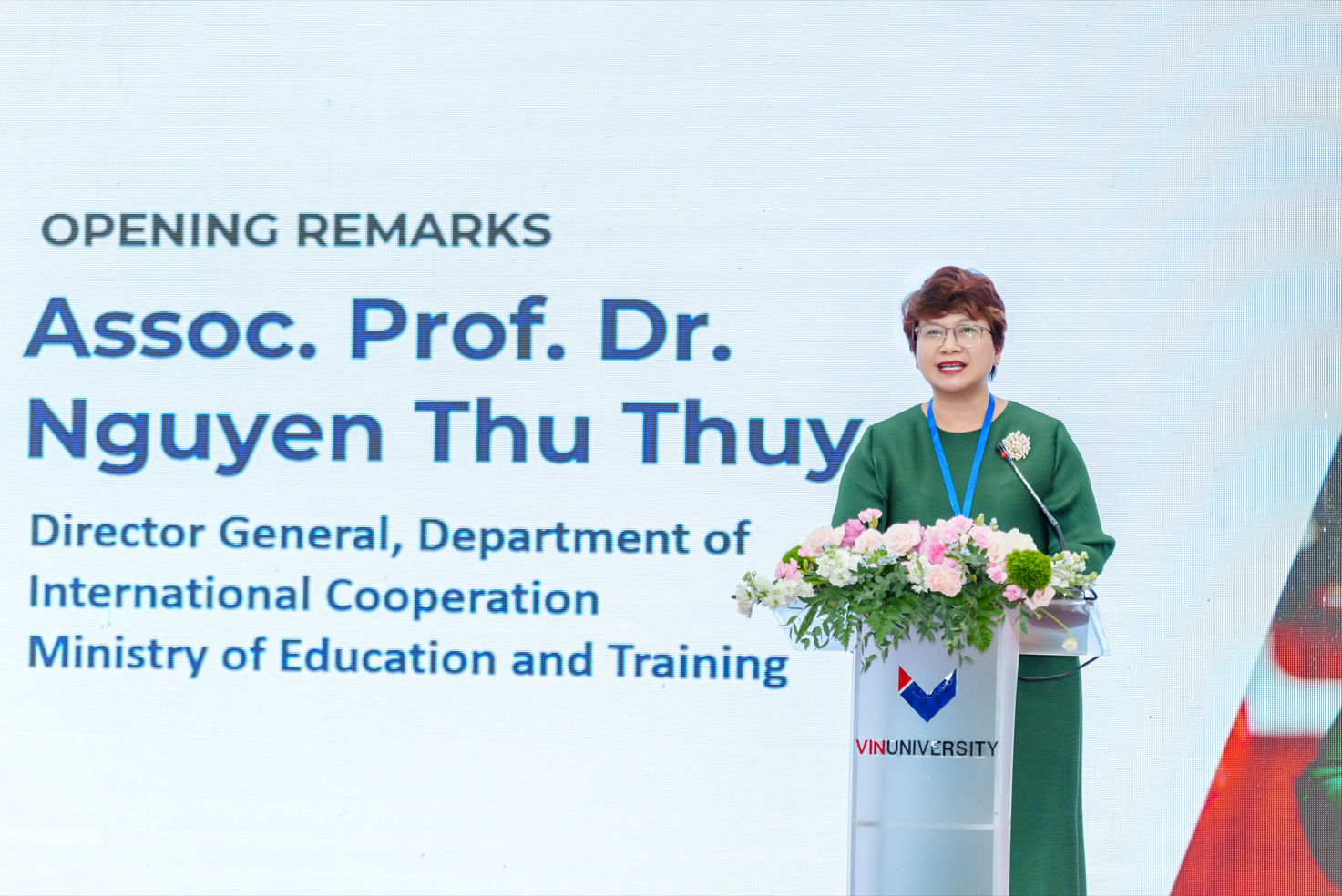
Assoc. Prof. Nguyen Thu Thuy, Director General of the International Cooperation Department, Ministry of Education and Training (MoET), delivering her keynote address on substantively elevating the global standing of Vietnamese higher education.
However, Assoc. Prof. Nguyen Thu Thuy, affirmed MoET’s consistent governance mindset: university rankings are not an end in themselves; schools should not develop education simply to chase mechanical positions on leaderboards.
“When approached correctly, prestigious rankings are crucial reference tools that help universities clearly identify their strengths, gaps, and distance from regional and international standards,” Assoc. Prof. Nguyen Thu Thuy said.
Assoc. Prof. Nghiem Xuan Huy, Director of the Institute of Digital Training and Testing at Vietnam National University, Hanoi, who has spent nearly a decade directly coordinating university ranking efforts, offered a highly “battle-tested” analysis. Assoc. Prof. Nghiem Xuan Huy frankly warned about the deep consequences of the “ranking game” that causes much anxiety in the higher education community. The manifestations of “gaming” are diverse and sophisticated. Assoc. Prof. Huy emphasized:
“Shortcuts might help a school jump ranks quickly and spectacularly, but they won’t last. Only rising through genuine quality creates sustainable development.”
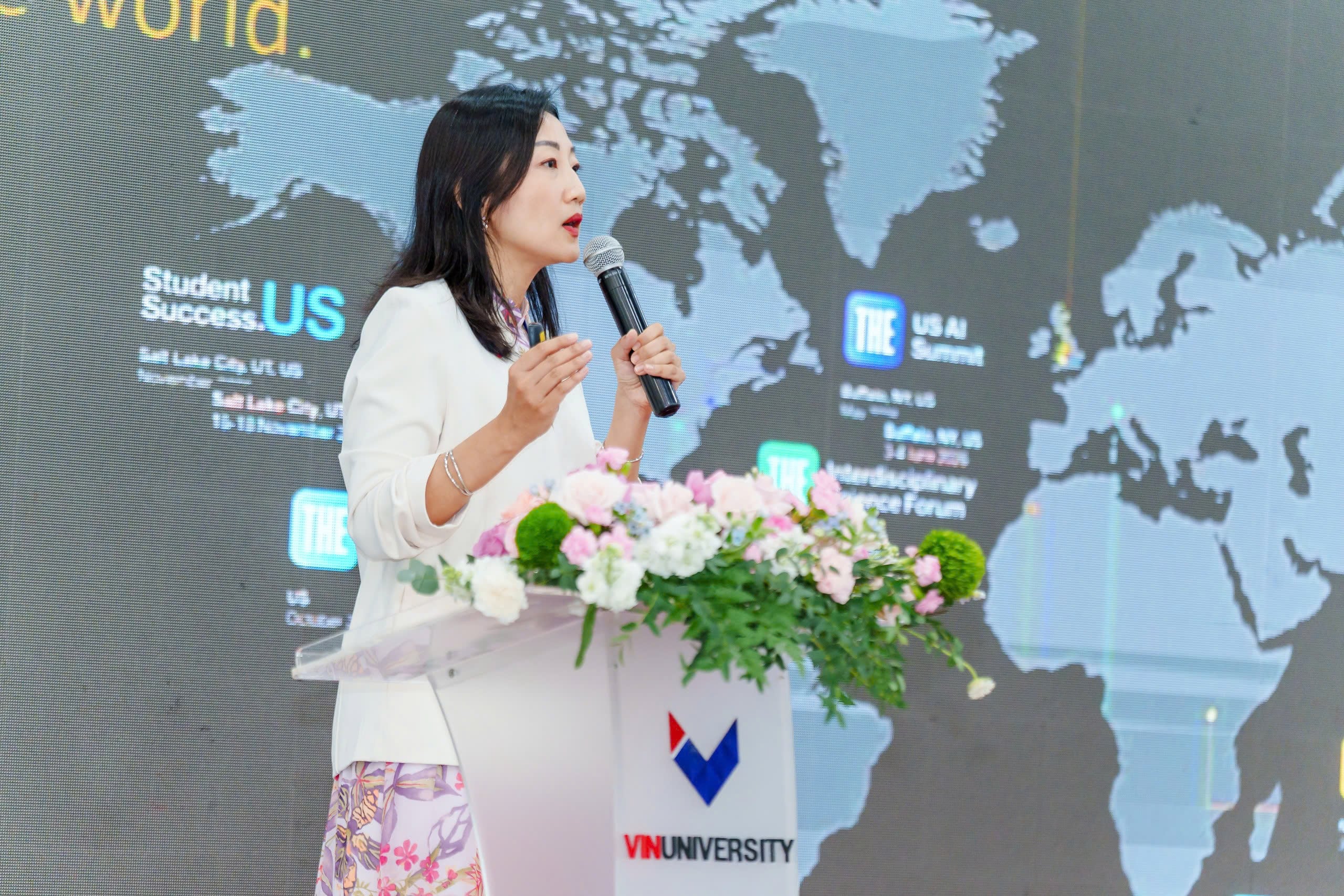
Ms. Mei Mei Lim, Regional Director for Asia-Pacific (APAC) of the Times Higher Education (THE) ranking organization, delivering the opening remarks of the event.
Ms. Mei Mei Lim, President of THE Asia-Pacific, revealed that THE has updated its methodology, adding three new indicators and establishing strict technical barriers along with various risk metrics to detect and prevent excessive self-citation exploited for ranking gains. This intervention aims to ensure the system accurately reflects the true value of academic integrity and substantive research quality.
Designing Strategic Mindset and the Courage to “Trade Off”
According to experts and administrators, to realize the ambition of substantive ranking advancement and core internationalization, the strategic decision-making capacity of leaders plays a pivotal role. Dr. Le Mai Lan, President of VinUniversity, posed three fundamental questions to educational administrators. Among them, the question regarding the roadmap requires immense courage and steadfastness.Dr. Le Mai Lan argued that in managing finite resources, prioritizing always comes with strict trade-offs in terms of staffing, budget, and time.
“If a leader wants to prioritize everything and treats every task as urgent, then in reality, nothing is a priority,” Dr. Le Mai Lan, President of VinUniversity said.

Dr. Le Mai Lan, President of VinUniversity, delivering the introductory speech at the seminar.
For instance, VinUniversity accepted a major trade-off by steadfastly choosing a lean and selective model: absolutely no expansion of undergraduate programs, strictly controlling the student population under 3,500, and channeling all expensive financial resources to attract elite global faculty and raise the postgraduate (master’s and doctoral) student ratio to 40%.
The trade-off for a world-class learning experience and a 40% international faculty ratio is an extremely high cost of training and a highly limited number of annual graduates (only about 500 students). VinUniversity also had to accept the challenges that come with cultural diversification, such as setting up a dedicated Halal kitchen, multi-faith prayer rooms, and multiplying internal communication efforts.
The Formula for Reaching Higher: Internal Strength – Support – Synergy
But how can we resolve the nation’s “knowledge trade deficit” paradox when the resources of individual universities are finite? According to Dr. Le Mai Lan, President of VinUniversity, to create a breakthrough on a national scale, the system must be placed within a collaborative, leading ecosystem.
“Internal strength is the foundation, support helps us accelerate, and synergy creates national status.” – Dr. Le Mai Lan, President of VinUniversity
A vivid illustration of this “synergy” philosophy is the story shared by Dr. Le Mai Lan, about the “EV charging research alliance.” Instead of working individually, VinUniversity, Hanoi University of Science and Technology, and the National University of Singapore (NUS) joined forces to establish a research alliance to solve the problem of optimizing costs and energy for EV charging stations, with a total investment of about $250,000 USD.
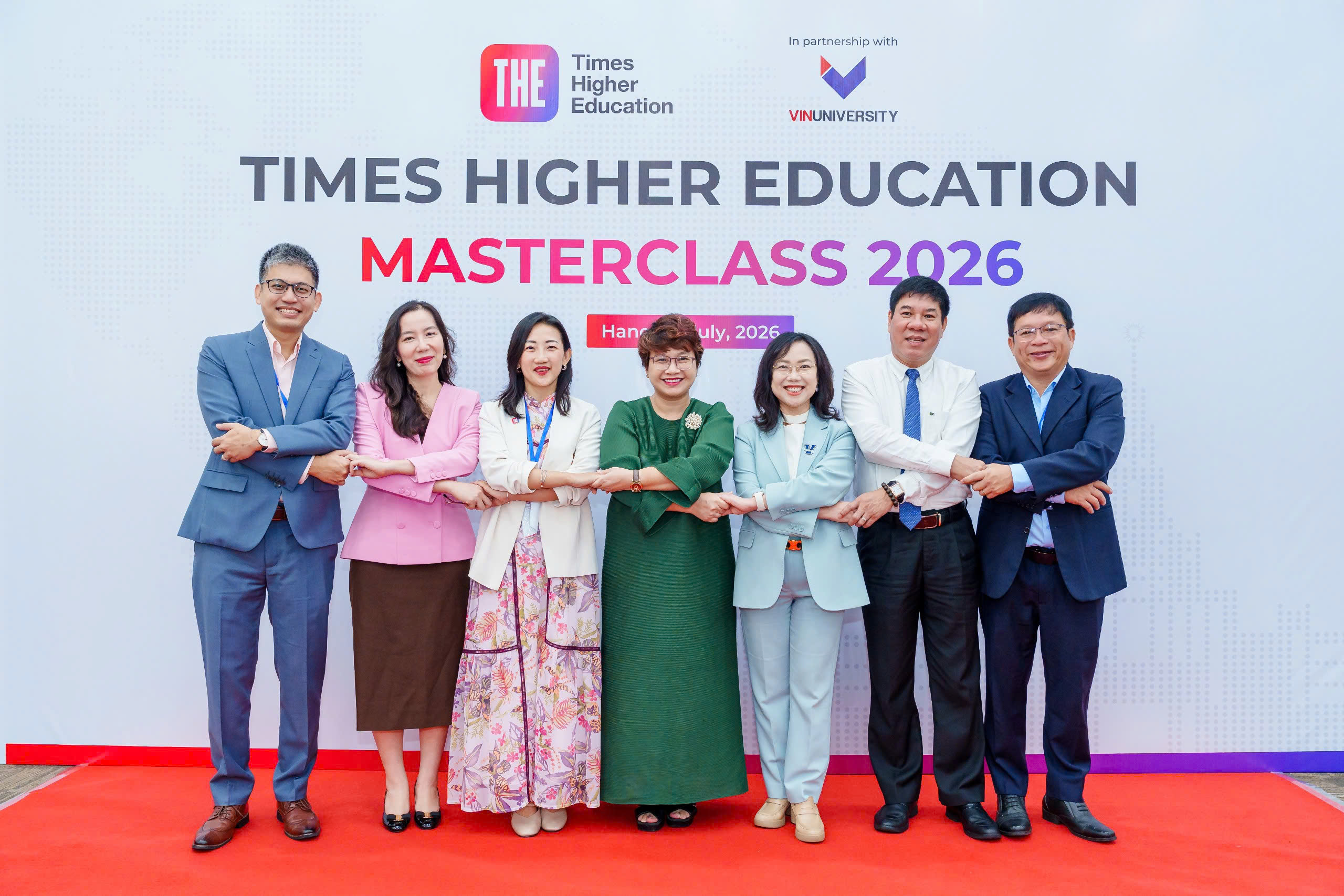
Representatives from the Ministry of Education and Training, Times Higher Education, VinUniversity, and Vietnamese universities at the seminar “From Data to Global Status: Research, Sustainable Development, and the Presence of Vietnamese Universities.”
The project’s success lies in the perfect integration of complementary strengths: NUS contributed a modern lab system and top-tier experts (including a Nobel laureate); Hanoi University of Science and Technology brought an incredibly practical faculty team; and VinUniversity contributed lab systems and highly valuable, real-world databases from VinFast, V-Green, and Vingroup.
The alliance’s outcomes went beyond prestigious international publications to birth the spin-off Voltera, a tech startup currently attracting significant interest from venture capitalists.
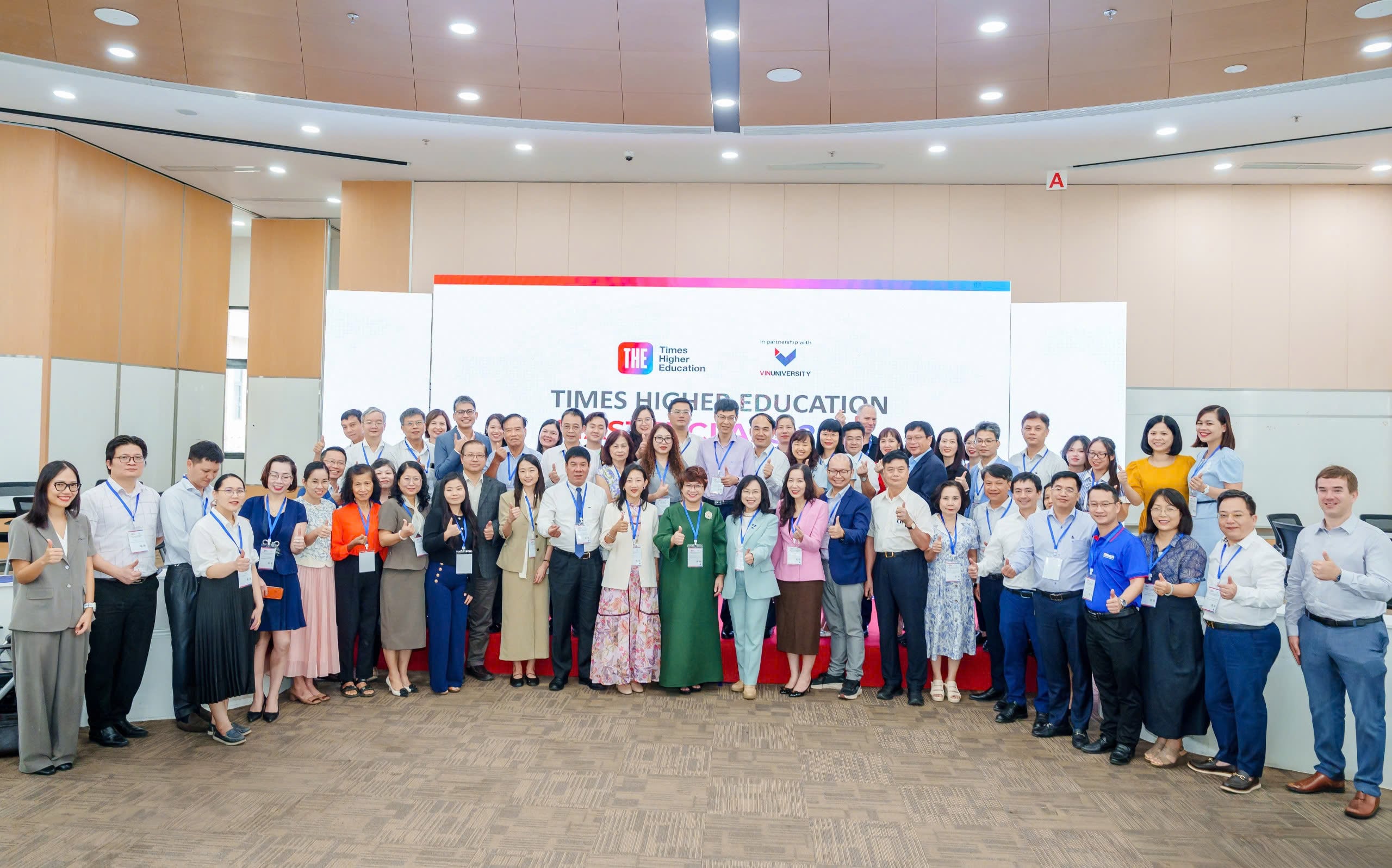
The seminar “From Data to Global Position: Research, Sustainable Development & the Global Presence of Vietnamese Universities” was jointly organized by VinUniversity and Times Higher Education (THE).
Dr. Le Mai Lan affirmed: “This collaboration does not diminish the competitive advantage of any individual school; on the contrary, it elevates the prestige of all participating members. When one Vietnamese university achieves good results, it is a shared accomplishment and the most positive signal elevating the image of the entire national higher education system.”
This philosophy resonated with Ms. Mei Mei Lim, President of THE Asia-Pacific, who later emphasized in her remarks: “A rising tide lifts all boats.” Ms. Lim noted that experience from rapidly developing countries in the region shows that universities within a nation must actively cooperate with one another rather than engage in fragmented internal competition.
