Can AI Be Woven Into Fabric?
July 3, 2026


Can AI Be Woven Into Fabric? The Era of “Thinking” Clothes Is Approaching
For millennia, fabrics have served a singular, passive purpose: providing mechanical protection and comfort. But what if your shirt could process information, monitor your cardiovascular health, and recognize when you are about to fall, all without a bulky battery or a smartphone? According to a comprehensive new review titled “Weaving Intelligence,” by a global consortium of researchers at Nanyang Technological University (NTU, Singapore), Switzerland Institute of Technology in Lausanne (EPFL, Switzerland), Technical University of Delft (TU Delft, Netherland), and Princeton University (Princeton, USA), and led by a team of the colleges of Engineering and computer science at VinUniversity, is answering a resounding “Yes” to whether artificial intelligence (AI) can be woven directly into everyday fabric. The perspective is published in Advanced Materials, the first ranked publication according to Google Scholar in Materials Science.
The key to this transformation is the evolution of fibers from simple threads into active, computationally capable material systems. By merging materials science with brain-inspired computing, researchers are paving the way for “third-generation” intelligent textiles where the fabric itself acts as a computer.
Scaling down the computer with “thermal drawing”
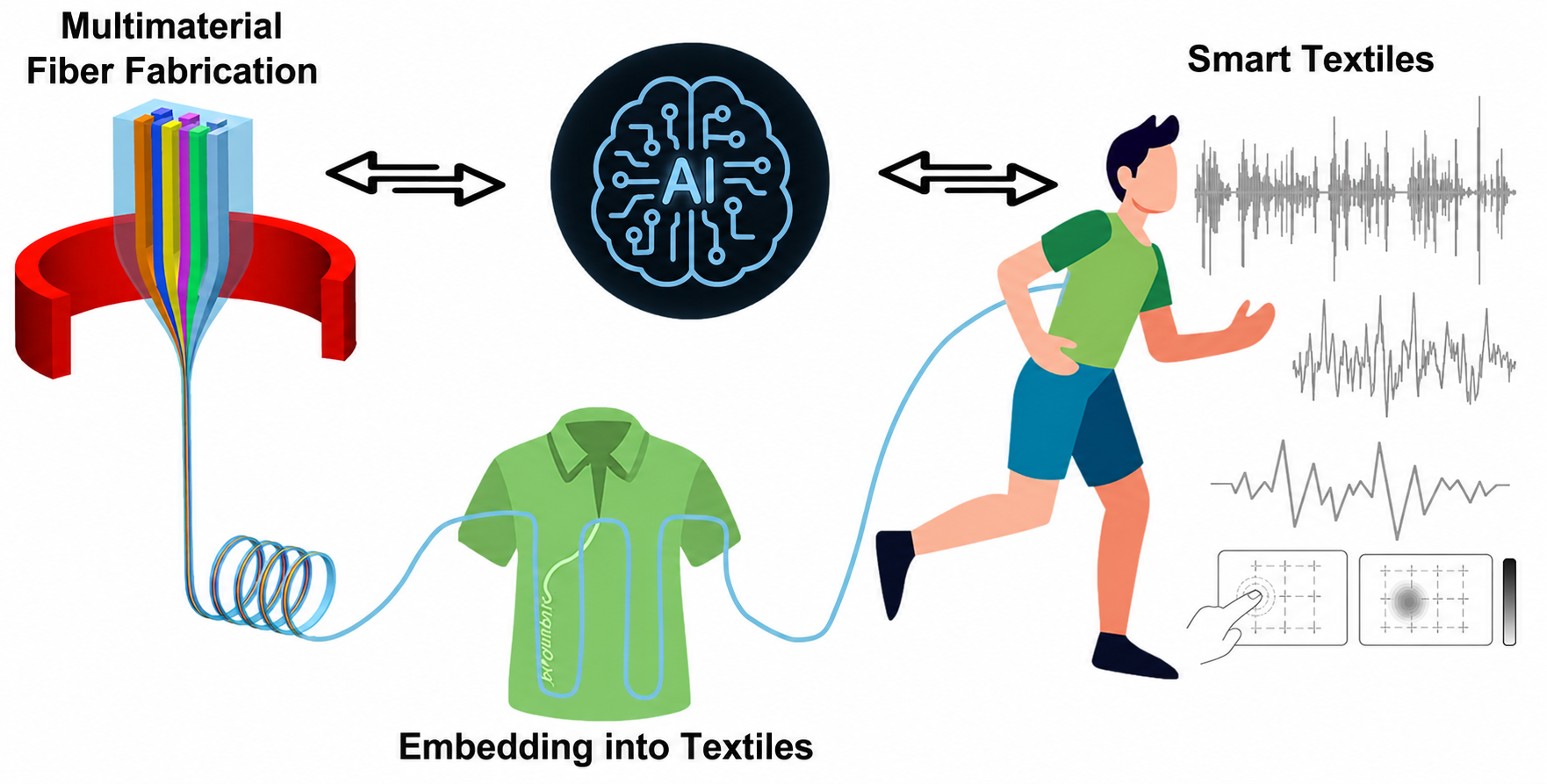
The foundation of this wearable revolution lies in a sophisticated manufacturing technique known as thermal drawing. Rather than awkwardly attaching rigid, traditional computer chips onto cloth, researchers assemble a macroscopic cylinder-a preform-containing an intricate arrangement of metals, semiconductors, and flexible insulators. By heating and stretching this block in a drawing tower, it is scaled down into a continuous, microscopic fiber.
This process perfectly preserves the complex internal architecture of the original preform, yielding a flexible, kilometer-long thread that intrinsically contains sensors, electrical wires, and even memory capabilities. When woven into textiles, these advanced fibers form the physical backbone of an intelligent, sensing network distributed across the human body.
Brain-like computation in your clothing
Processing the massive amount of data our bodies continuously generate-such as heartbeats, muscle movements, and temperature changes-typically requires sending information to the cloud or a smartphone, which drains battery life and causes processing delays. To solve this, researchers are designing fibers that could process data locally by mimicking the human brain using Spiking Neural Networks (SNNs).
Unlike conventional artificial neural networks that require continuous, power-hungry computation, SNNs operate on discrete “spikes” of information, much like biological neurons and synapses. An SNN-enabled fiber only activates, or “fires,” when it detects a specific event, such as a sudden change in pressure or temperature. This bio-inspired, event-driven approach consumes an incredibly low amount of power, making it perfectly suited for garments where energy resources are highly limited. Essentially, the fibers themselves encode, store, and process sensory data locally within the material.
A distributed network of intelligent threads
When these intelligent fibers are interwoven, they form a cohesive “fabric brain.” Instead of relying on a single sensor on a wrist, a smart shirt features distributed fibers that can communicate with one another. For example, in tests analyzing human physical activity, isolated fibers achieved an average accuracy of ~67% on their own; however, when four fibers (one per limb) collaboratively classified the activity through weighted voting, accuracy increased to nearly 95%.
The real-world applications for this technology are vast. For instance, in precision healthcare and ambient intelligence, garments embedded with multimaterial fibers can continuously monitor physiological signals like heart rate and respiratory dynamics without obtrusive hospital equipment. In elderly care, intelligent bedsheets and rugs can unobtrusively track daily activities and instantly detect falls, alerting caregivers in real-time while fully preserving user privacy. As for robotics and other human-machine interaction, fiber-embedded gloves can capture fine motor activities, enabling real-time sign language translation or allowing users to intuitively navigate unmanned aerial vehicles (drones) and virtual reality environments simply by moving their fingers.
The bright future ahead
While the vision of intelligent textiles is rapidly coming into focus, researchers note that several hurdles remain. Establishing reliable electrical contacts that can survive washing, perspiration, and repeated stretching is an ongoing challenge, as is the need for integrated energy harvesting (like capturing body heat or movement) to keep the garments fully autonomous.
Despite these obstacles, the convergence of thermal drawing and artificial intelligence marks a total paradigm shift. As fibers continue to integrate sensing, memory, and neuromorphic computation, the clothes of the future will do far more than keep us warm-they will become dynamic, self-aware systems capable of learning, predicting, and adapting to our needs.
Read the full research here: https://advanced.onlinelibrary.wiley.com/doi/10.1002/adma.73574
