Chasing clearer skies: Dr. Kumar Vikrant’s global journey toward atmospheric resilience
July 6, 2026


The most dangerous air pollutants are often the ones you cannot see, smell, or easily capture. Dr. Kumar Vikrant has dedicated his career to solving exactly that problem – and he is now doing it from Hanoi, with Vietnam’s own rare earth resources.
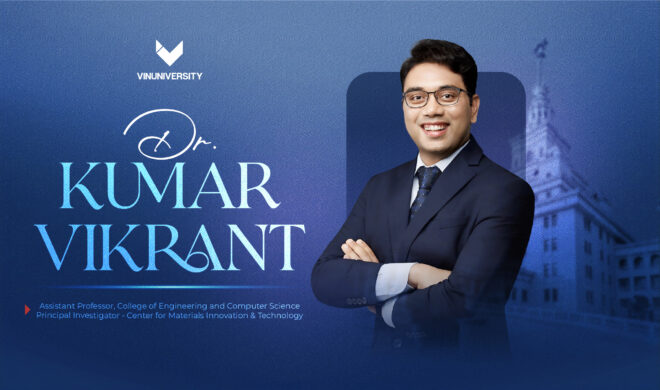
As an Assistant Professor in the College of Engineering and Computer Science (CECS) and Principal Investigator at the Center for Materials Innovation and Technology (CMIT), Dr. Vikrant’s work focuses on the intersection of advanced materials and environmental remediation. Consistently named among the world’s top 2% of scientists in Earth and Environmental Sciences and Chemical Engineering since 2021 according to data compiled by Elsevier, his academic journey represents a continuous evolution across three distinct regional ecosystems: Patna, where his environmental consciousness was first awakened; Seoul, where he forged his rigorous scientific standards; and Hanoi, where he is now building an independent laboratory dedicated to sustainable, real-world solutions.
From Nalanda’s Legacy to India’s Hazy Skies
Dr. Vikrant’s intellectual roots trace back to Patna, the capital of Bihar, India. Growing up in a region near the historic ruins of Nalanda, the world’s first residential university, and Bodh Gaya, where Siddhartha Gautama attained enlightenment, he was raised with a profound reverence for scholarship. “Visiting these ancient sites with my parents instilled in me a deep desire for learning and academic pursuit,” Dr. Vikrant recalls.
That early curiosity was soon confronted by the tangible environmental challenges of rapidly developing Indian cities. Growing up amidst the persistent haze of urban air pollution, environmental issues were not abstract concepts to be read about in textbooks; they were a daily reality. This lived experience fundamentally shifted his academic interest. While he was initially drawn to the practical, problem-solving nature of chemical engineering when he entered the Indian Institute of Technology (Banaras Hindu University) Varanasi – admitted through the highly competitive IIT-JEE, which has an acceptance rate of less than 1% – his focus naturally drifted toward environmental remediation.
Varanasi became crucible for his initial scientific discoveries. Joining the environmental engineering laboratory of Professor Ram Sharan Singh, Dr. Vikrant worked on developing sustainable biochar-based materials to capture air pollutants. Witnessing his undergraduate research being accepted and published in peer-reviewed international journals was a transformative moment. The process of taking raw laboratory data, shaping it into a coherent scientific narrative, and contributing to the global body of knowledge gave him a clear conviction: research would be his lifelong path.
Internalizing the “Standard of Excellence” in Seoul
His dedication to environmental engineering led him from the banks of the Ganges to the dynamic metropolis of Seoul. Awarded a full scholarship through the Hanyang International Scholarship Program in 2018, Dr. Vikrant joined the Air Quality and Materials Application Laboratory at Hanyang University under the guidance of Professor Ki-Hyun Kim, a world-renowned Highly Cited Researcher (HCR).
In Seoul, Dr. Vikrant underwent a rigorous transition from a promising student to a world-class researcher. Professor Kim’s laboratory operated under an uncompromising “standard of excellence,” characterized by high scientific ethics, intense focus, and a deep-seated responsibility to contribute to top-tier international journals. “The laboratory atmosphere was not one of comfort, but of intense focus, immersion, and healthy competition,” Dr. Vikrant notes. “It mirrored the fierce competition of the global academic community, which became a powerful driving force.”
Equipped with state-of-the-art analytical instrumentation, Dr. Vikrant immersed himself in experiments. His doctoral research targeted one of the most stubborn indoor air quality challenges: the removal of formaldehyde (HCHO). A Class 1 human carcinogen, formaldehyde is notoriously difficult to capture due to its small molecular size and extremely low boiling point. By designing advanced functional materials, Dr. Vikrant developed highly efficient adsorption and catalytic techniques to neutralize this threat, earning Hanyang University’s outstanding PhD dissertation award twice.
Yet, Dr. Vikrant’s time in Korea was defined by more than just laboratory breakthroughs. Seeking intellectual balance, he took a scholarly writing class that introduced him to Professor Joseph Yi from the Department of Political Science and Diplomacy. The two developed a deep intellectual friendship, discussing Stoic philosophy and existentialism-philosophical frameworks that helped Dr. Vikrant maintain perspective amidst the pressures of high-level research. He even shared his cultural and philosophical reflections with a wider audience, publishing several essays in The Korea Times.
During his seven years in Seoul, Dr. Vikrant also adapted to the high-efficiency, fast-paced Korean culture, explored the country’s public transit network, and, most importantly, married his wife, who joined him in embracing life in South Korea. By the time he completed his tenure as a Research Assistant Professor at Hanyang, he had not only published extensively but had also developed the resilience, adaptability, and vision required of a global scientist.
The VinUniversity Era: Building an Independent Scientific Frontier
In September 2025, Dr. Vikrant made a pivotal transition by joining VinUniversity in Hanoi as an Assistant Professor.
For an ambitious young investigator, VinUniversity offered an ideal environment. The university’s modern research infrastructure, its interdisciplinary focus, and its active collaborations with prestigious global institutions like Cornell University and the University of Pennsylvania provided the perfect platform for independent innovation.
At VinUniversity, Dr. Vikrant is focused on building a laboratory culture that mirrors the high academic standards of his training while remaining deeply collaborative and supportive. He envisions his lab not merely as a production line for scientific papers, but as a mentorship incubator. “It is about creating an environment where young Vietnamese engineers and researchers can learn the rigorous methodology of top-tier global publishing, while feeling supported to take creative risks,” he explains.
Localized Innovation: Advanced Catalysis for Vietnam’s Skies
Currently, Dr. Vikrant’s laboratory at VinUniversity is tackling a critical environmental challenge: industrial emissions of multi-component Volatile Organic Compounds (VOCs). In rapidly industrializing nations like Vietnam, factories emit a complex cocktail of these organic chemicals. Once in the atmosphere, VOCs undergo complex chemical reactions to form secondary pollutants, such as ground-level ozone and fine particulate matter, which pose severe risks to human health.
Traditionally, industries have relied on thermal incineration to destroy VOCs. However, this method is highly energy-intensive and often leads to the unintended generation of secondary pollutants like nitrogen oxides.
Dr. Vikrant’s team is pioneering a green alternative: solar-powered photothermocatalysis. Rather than relying on massive external energy sources to heat reactors, this technology leverages Vietnam’s abundant sunlight. By designing advanced catalysts that simultaneously harvest solar heat (thermal energy) and light (photon energy), the laboratory aims to completely oxidize harmful VOCs into harmless carbon dioxide (CO2) and water (H2O) at much lower, energy-efficient temperatures.
To make this technology truly sustainable and economically viable for local industries, Dr. Vikrant is looking to Vietnam’s natural resources. Vietnam holds the world’s second-largest Rare earth resource potential – materials that possess unique electronic and catalytic properties. By utilizing these locally sourced rare earth elements to engineer the catalysts, Dr. Vikrant’s laboratory is turning a domestic resource into a high-performance solution for cleaner air.
Borderless Science for a Shared Planet
While Dr. Vikrant’s current research is grounded in the industrial realities and natural resources of Vietnam, the scientific outcomes are inherently borderless. The catalysts developed in Hanoi are designed to contribute to the global catalog of green technologies, offering scalable solutions for environmental remediation worldwide.
Reflecting on his journey, Dr. Vikrant sees a continuous thread that connects Patna, Seoul, and Hanoi. The child who once looked up at the hazy skies of Patna is now a researcher in Vietnam, working at the molecular level to solve the very problems that shaped his youth. At VinUniversity, Dr. Vikrant is not only chasing clearer skies for the next generation but is also building the scientific infrastructure and mentoring the future innovators who will help protect them.
