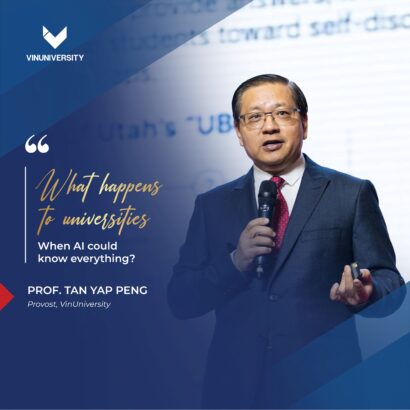
What happens to universities when AI could know everything? VinUniversity Provost lays out the university’s next priorities
March 14, 2026


On the New Year occasion, our Provost Tan Yap Peng posed a question that many universities around the world are quietly beginning to confront: What happens to universities in the era of AI?
Artificial intelligence is reshaping a centuries-old assumption about higher education. For generations, universities have been the gatekeepers of knowledge, credentials, and elite networks. Students came to campus to gain access expertise that was otherwise difficult to reach.
“That’s era is ending”, said our Provost Tan.
AI is dissolving the traditional monopoly on knowledge. Expert-level information is now accessible almost anywhere, anytime. In such a world, universities must rethink their purpose. In such thought-provoking topic, our Provost share 4 key opinions:
Against this backdrop, our Provost emphasized that VinUni’s strategic direction is clear. Rather than reacting to AI disruption, the university aims to build a human-centered, AI-powered institution shaping the future of education, guided by three calls to action:
Let’s read such an insightful speech in full below!
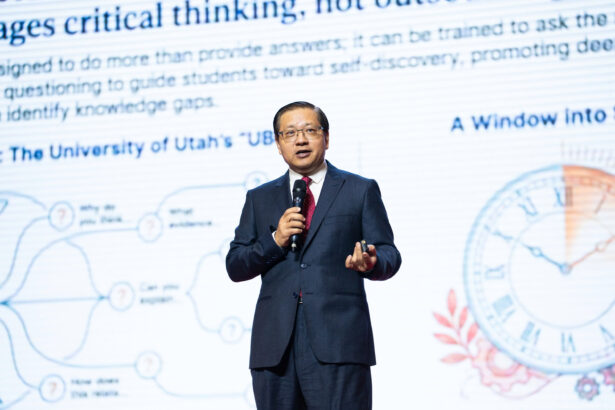
“For decades, universities have been the gatekeepers of knowledge, talent networks, and trusted credentials. Students came to universities to learn, connect, and be certified.
That era is ending.
AI has broken the monopoly. Today, knowledge is no longer scarce. It is abundant, instantaneous, and generative. Anyone, anywhere, can access solutions, simulations, and expert-level insights on demand. Talent networks are no longer confined to campuses; they are global, digital, and AI-enabled. Even credentials are no longer bulletproof in a world where machines can produce outputs once requiring deep expertise.
In just three years, AI has evolved from answering simple prompts to demonstrating PhD- and expert-level competence across multiple fields. When knowledge becomes a commodity, ubiquitous like water or electricity, we must ask a fundamental question: What role should universities play in nurturing talent and future leaders? What research should universities prioritize to address the most important and difficult challenges?
This requires us to redesign our teaching, research and service.
As AI can take action based on human instruction, we must cultivate capabilities that remain distinctly human: judgment, first-principles thinking, creativity, empathy, ethical reasoning, problem framing, and responsible leadership. Our students and researchers must not be mere users of AI, but leaders who can manage and direct machine intelligence with purpose and character.
AI can generate answers, faster and often more comprehensively than humans. But it cannot define purpose, ask the right questions, or decide what truly matters.
The true competitive advantage will not belong to “AI specialists” who simply use AI tools. It will belong to AI-empowered experts – engineers, social scientists, business leaders, and medical doctors with deep domain mastery, who use AI as a multiplier to speed understanding, supercharge problem-solving, and tackle complex, real-world challenges.
The goal is not to work harder or faster, but to solve problems once beyond our physical and cognitive limits. The most critical capability we must cultivate is learning velocity – the ability to learn quickly, unlearn outdated mindsets, and relearn continuously. This applies not only to our students, but to our faculty, researchers, and administrators.
During the Tradition Day, I spoke about the advantages of newcomers. Newcomers move faster because we have less legacy to protect and fewer past successes to defend. Newcomers can win by learning faster, building quicker, and moving bolder, before existing leaders can let go of the past. Being new and cautious is fatal. Being new and bold is powerful.
This is our moment.
Let us build VinUni not as a university reacting to AI, but as a human-centered, AI-powered university, guided by three calls to action.