Volterra: VinUniversity Startup Addressing Energy Challenges for One Million Electric Vehicles Through AI and Digital Twin Technology
March 13, 2026



01. Solving the Grid Load Problem
In mid-2025, when VinUniversity announced its new development strategy with a Vision 2030 framework, the university set an ambitious goal: its research programs would contribute to solving 100 real-world science and technology challenges. Volterra is one such project.
Among the most pressing challenges that scientists at VinUniversity identified is ensuring grid stability as the number of battery-powered vehicles grows rapidly. According to expert projections, by 2030, the number of electric vehicles in Vietnam could reach one million. To power that fleet, Vietnam will need not only a significant expansion of charging infrastructure, but also concrete answers to a fundamental question: where will the electricity come from?
In practice, Vietnam – like most developing countries – faces a core paradox: electric vehicles reduce emissions and improve air quality, delivering clear public health benefits, yet charging infrastructure creates substantial pressure on the power grid. If charging stations rely primarily on the existing grid, peak-hour overloads become difficult to avoid. Conversely, expanding the grid solely to meet short-term demand spikes would require enormous investment and risk wasting resources.

Faced with this challenge, Prof. Laurent El Ghaoui – a world-leading expert in optimization, Vice Provost of Research and Innovation, and Director of VinUniversity’s Center for Environmental Intelligence – and his colleagues at VinUniversity posed a core question: how can a charging solution be built that reduces dependence on the grid while remaining economically viable and scalable under Vietnam’s real operating conditions?
To address this, the research team developed an integrated solution combining Battery Energy Storage Systems (BESS) with charging infrastructure. At the center of the model is a platform integrating artificial intelligence and Digital Twin technology, enabling real-time simulation, forecasting, and operational optimization of charging stations. Built on this foundation, multi-level optimization algorithms, dynamic load management, and game theory are applied to simultaneously address two layers of the problem: energy optimization and user behavior.
Conventional electric vehicle charging stations currently perform only one function: supplying electricity to vehicles. They have no visibility into whether the broader grid is operating under surplus or stress. During peak hours, multiple vehicles may charge simultaneously at a single station, causing sudden spikes in grid load and higher charging costs. During off-peak hours, the infrastructure sits largely idle – a significant waste of resources.

According to Dr. Nguyen Phi Long, a member of the research team, the AI and Digital Twin solution functions as a “system coordinator,” constructing optimal operating scenarios for the entire network. Each physical charging station has a corresponding digital replica, within which operating scenarios are continuously simulated, tested, and adjusted based on real-time data.
Volterra’s AI system does not simply observe charging demand at a given moment. It analyzes historical usage patterns, forecasts upcoming load peaks, and calculates how energy should be distributed across multiple sources. When to prioritize renewable energy, when to charge or discharge storage systems, when to draw from the grid – all of these decisions are considered within a single comprehensive optimization framework, with the goals of reducing costs and maintaining operational stability.
“More importantly, Volterra is capable of coordinating at the network level. When a station approaches its load threshold, the system proactively redistributes demand to other stations with available capacity, or encourages users to charge at more suitable times through pricing and service incentives. As a result, charging infrastructure no longer responds passively to market demand – it becomes a flexible, self-adjusting system capable of adapting to the dynamics of the electric vehicle market,” explained Dr. Do Danh Cuong, Head of the Research Team.
Based on simulation scenarios conducted for Vietnam, Volterra’s solution has the potential to reduce operating costs by up to 40%, triple return on investment, and significantly cut greenhouse gas emissions when integrated with renewable energy sources.
02. From the Lab to the Market
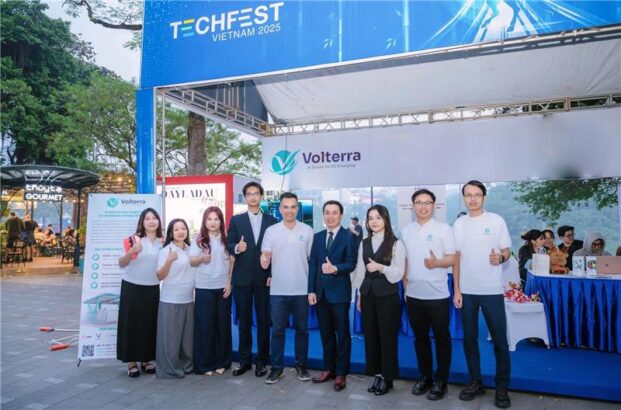
In the startup world, a “spin-off” refers to a business idea originating from academic research, developed to transfer knowledge and technology from a university to the market and broader society. Volterra fits this model precisely.
Dr. Do Danh Cuong noted that once the primary scientific challenge had been resolved, a business concept began to take shape. VinUniversity’s Entrepreneurship Lab (ELab) brought entrepreneurially minded students into the research process and market exploration activities, adding practical, multi-dimensional perspectives to Volterra’s scientific foundation. At the same time, the research team progressively transitioned into a product development unit within the startup.
As a result, Volterra operates through two interconnected feedback loops, each sustaining the other. The first is the research development loop. Beginning with foundational questions about energy optimization, load coordination, and complex system operations, the team continuously builds models, tests hypotheses, and publishes academic findings. Each research outcome opens new possibilities for the system.
The second is the business operations loop. Volterra is deployed in specific application contexts to assess its effectiveness. Feedback from these deployments is then channeled back into the research process. This engagement with the market has helped the team refine algorithms, streamline models, and more clearly identify the core value that drives the strongest business outcomes.

In the conventional Lab-To-Market model, scientific initiatives typically receive market feedback only at Stage 6 – the pilot production phase. Volterra’s circular loop structure, however, allows the team to access market feedback from Stage 3, the research orientation phase. Progress in each loop generates momentum for the other, forming a continuous cycle between the laboratory and real-world conditions – and back again.
“This structure has defined Volterra’s identity as a genuine spin-off – a project where science and business can move in the same direction, driven by a shared ambition to deliver the most effective EV charging solutions for people in Vietnam,” Dr. Cuong emphasized.
To date, within six months of development, Volterra has successfully brought three product lines to market from its core technology platform: fixed charging stations, flexible charging stations, and autonomous charging robots. Each product line carries its own strengths, reflecting the diverse and practical approach of a research-driven spin-off.
According to Ms. Nguyen Minh Phuong, Director of the Entrepreneurship Lab (ELab), Volterra’s ability to move to market quickly is largely attributable to VinUniversity’s evolving policies on the access and commercialization of scientific innovations.
“VinUniversity has proactively expanded commercial exploitation rights for research outputs, supported licensing costs in early stages, and maintained a collaborative mechanism to help bring scientific ideas to market. Through these changes, we want to make clear that every laboratory at VinUniversity is open to entrepreneurs,” said Ms. Phuong.
03. Science in Service of Society
In a world navigating significant uncertainty, the principle of connecting science to real societal challenges is becoming increasingly important. Prof. Laurent – whose work places him among the top 2% of the most-cited researchers globally – argues that the traditional research model now faces new pressures.
In his view, the conventional research model rooted in 19th-century German academia often sees scientists spend many years on foundational work before asking: “Why does this research matter?” “What concrete benefit does it offer society?” or “Where does its commercial applicability lie?” As research funding faces cuts across many countries, this traditional approach shows clear limitations.
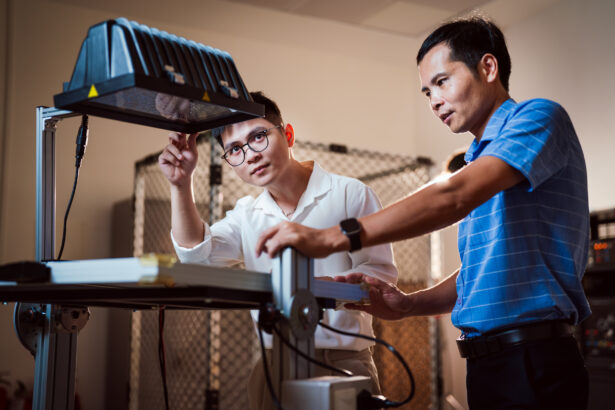
From this perspective, VinUniversity’s Vision 2030 adopts a more flexible research approach. Research teams are encouraged to pursue multiple questions in parallel from the outset: What is the scientific value of the work? What real societal problems can it address? And where does its potential for application or commercialization reside?
This approach helps narrow the gap between academic research and practical impact. While many large technology corporations in the United States are scaling back their investment in academic research, VinUniversity has chosen a different direction – forging closer connections between academic inquiry and the concrete needs of society and industry.
“For me, the most important purpose of science is to create positive impact. So let’s start with research that has commercial potential – that is how we build trust within the community. I also believe that commercialization, innovation, and entrepreneurship are all vitally important, and should be embedded in research projects from the earliest stages,” said Prof. Laurent.
Mr. Tô Văn Lãng, CEO of Volterra, expressed the same confidence in this approach. “A product grounded in scientific depth, built on core technology developed and refined at a research university, will have far greater potential for long-term competitiveness and lasting social impact,” he said.
Volterra is now operating as a fully functioning enterprise. Like many startups, the road ahead will involve navigating uncertainty and responding to market volatility. Yet it is precisely that uncertainty which reflects the spirit of a genuine spin-off – one where academic research dares to leave the ivory tower and contribute to the broader community, and where scientific knowledge chooses the vitality of the market to test and sharpen its most promising ideas.