Turning 2D nanomaterials into 3D-printed smart devices: a sustainable breakthrough
September 22, 2025


Imagine this: from nanosheets only a few atoms thick, science can 3D-print smart devices that are not only sustainable but also capable of reshaping how we care for our health and use energy. That is the spirit of Horizons 2025 – where breakthroughs are told in the language of the future.
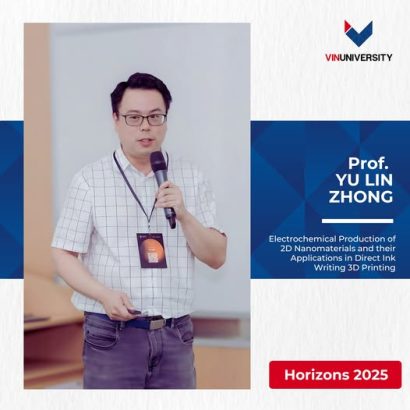
At Horizons 2025, hosted by VinUni, Professor Yu Lin Zhong (Griffith University) introduced a green electrochemical method to produce graphene oxide and MXenes: ultra-thin nanosheets only a few atoms thick, stronger than steel, highly conductive, and notoriously difficult to synthesize at large scale.
These 2D materials were then transformed into 3D-printable inks, unlocking the creation of:
This work bridges sustainable material production with advanced 3D printing, showing how cutting-edge science can yield functional devices for healthcare and energy while remaining eco-friendly and scalable.
Why it matters? By hosting Horizons 2025, VinUni brings together global experts like Professor Yu Lin Zhong with young researchers, accelerating discoveries in materials, AI, and automation – laying the foundation for a “green leap” in Vietnam and beyond.