Responding to Fuel Price Volatility: Designing an Economic Support Package Early
March 12, 2026


The effects of global energy supply disruptions and rising fuel prices could create significant difficulties for people’s livelihoods and businesses. It is therefore necessary to design a comprehensive policy support package early to better respond to market volatility and avoid the risks of stagflation.
This was the recommendation of Dr. Nguyen Tu Anh – Director of Macroeconomic Policy Research at Green-X Smart Green Transformation Center, VinUniversity – in a conversation with Tuoi Tre newspaper.
He argued that the ongoing conflict in the Middle East and fluctuating oil prices are directly affecting all aspects of daily life and the economies of many countries, including Vietnam.
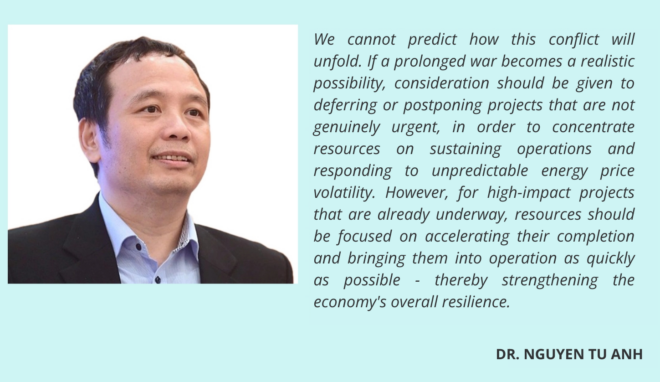
Preparing for a Prolonged Conflict Scenario
* What specific disruptions are you referring to, and what are their implications?
– The impacts and pressures depend heavily on whether the conflict in the Middle East ends soon or drags on. If it concludes within the next few weeks, the effects would be temporary – the Strait of Hormuz would reopen and shipping routes through the Red Sea would no longer be threatened.
In that scenario, energy supply would be restored and the recent fuel price increases would be resolved quickly. That is the most hoped-for and optimistic outcome. WTI crude futures for three and six months are currently anchored around $80-85 per barrel, suggesting markets lean toward this scenario.
However, we must also prepare for worse outcomes, since there is no certainty about when hostilities will end. The greatest risk facing all countries is stagflation – simultaneous inflation and economic recession.
This is not unprecedented. The oil price crisis of the 1980s-1985 triggered severe stagflation across the region and in Western countries: inflation driven by soaring energy prices, and recession driven by rising production costs.
From there, a recessionary cycle takes hold: people tend to seek safe-haven assets such as gold, foreign currencies, and real estate. This drives asset prices up, pushing inflation higher. Capital outflows intensify pressure on the exchange rate. These factors compound rising input costs, pushing the economy into deeper recession and higher inflation.
Vietnam’s real estate market is heavily debt-dependent. In a stagflationary environment, surging borrowing costs increase the risk of a real estate bubble collapse – posing serious challenges to the banking system that require careful, thorough assessment and early response strategies.
Three Immediate Response Measures
* What solutions should be prioritized at this time?
– First, ensuring fuel supply security must be the top priority – meaning diversification of supply sources. If supply from Middle Eastern countries is constrained, alternative sources must be sought by all available means.
We have relevant experience here. During the COVID-19 pandemic, vaccine diplomacy helped Vietnam navigate the crisis remarkably well. A similar approach – leveraging both diplomatic and economic channels – is needed to secure fuel supply and national energy security.
Second, maintaining relatively stable foreign exchange reserves is essential in monetary policy. As a country heavily dependent on imported oil and raw materials, Vietnam cannot allow foreign currency reserves to drain too rapidly.
A range of policies should be implemented to encourage exports, prioritizing them as a means to build foreign exchange reserves and sustain energy imports as prices rise.
Third, fiscal policy must serve a dual purpose: maintaining stability and sustainability while also supporting the broader economy.
This means balancing significant spending to ensure energy security and support oil import companies in sourcing supply, while also maintaining fiscal balance to reinforce confidence in the government’s stability commitments and anchor recovery expectations.
Initial fiscal measures – such as exempting import taxes on fuel and drawing from the price stabilization fund – have already been implemented relatively quickly. But if prices continue to climb, retail price support from the state budget will need to be considered. This could take the form of direct subsidies, further tax reductions, or state-guaranteed loans channeled through bank refinancing to keep retail prices from rising too sharply.
Keeping Inflation Within Acceptable Bounds
* People are worried that rising fuel prices will push up the cost of goods. How do these policies help control inflation?
– Monetary policy plays a critical role in managing inflation expectations. As fuel prices continue to rise, supply shortages generate inflationary expectations, increasing the risk of broader price increases.
Inflation must therefore be kept within acceptable bounds – not allowed to spiral uncontrollably, but also not suppressed so aggressively that it constrains growth. Policymakers need to strike a delicate balance and follow market developments closely.
It is also important to ensure coherent coordination between fiscal and monetary policy to support priority economic sectors. For example, incentives could be introduced to encourage the sharing economy, increase public transport use, reduce private vehicle usage, lower fuel consumption, and cut other related costs.
Investment in new and renewable energy sources and accelerated adoption of electric vehicles should also be encouraged.
This represents structural monetary policy – using state budget resources to direct monetary policy toward priority sectors. Monetary instruments should incentivize both increased fuel supply and the development of renewable and alternative energy, reducing dependence on fossil fuels.
The state can facilitate this through bank refinancing, lending to commercial banks on the condition that funds are disbursed to designated priority sectors.
Design a Support Package Now
* Fuel prices have risen sharply in a very short time – diesel, a key production input, has increased by as much as 70-80%. Is it time to design a policy support package?
– I believe a support package must be designed immediately – not after prices deteriorate further. Recent fuel price movements represent a major shock. While global oil prices have not yet reached 2022 levels of $114-120 per barrel, domestic prices have adjusted significantly higher because the Vietnamese dong has depreciated considerably against the US dollar over the 2022-2025 period.
The combined effect of a stronger dollar and rising oil prices has put substantial pressure on the economy – particularly as fuel and petrol prices have risen by approximately 70%, driving up production and service costs significantly.
We face a clear choice: either allow prices to follow world markets, or maintain stable retail prices. Stabilizing prices may require fuel importers to absorb losses in the short term, but it would generate greater added value for the broader economy.
As previously outlined, fiscal tools are available to do this. The state can deploy emergency policy packages to provide immediate price support for businesses and households facing this price shock.
For example, the state could subsidize fuel retailers, or provide guarantees or grants allowing companies to borrow and cover the gap created by rising prices. These loans would be repaid once businesses return to profitability. These are instruments the government is fully capable of deploying.
The Case for Strategic Reserves
* What lessons can be learned from recent experience, and what are your recommendations?
This situation is a powerful lesson in the need for more urgent measures to ensure the long-term stability and sustainability of the fuel market and national energy security. Our current approach focuses primarily on financial stabilization, while physical stabilization remains underdeveloped.
In other words, we assume that having the money to purchase fuel from abroad is sufficient – but recent events have shown that having money does not guarantee access to supply. Only physical price stabilization mechanisms – namely strategic stockpiles – can address this problem.
In a context where double-digit growth driven by digital transformation and artificial intelligence is a national priority, ensuring energy security is absolutely essential.
The government has made significant efforts to diversify energy sources and develop renewables. However, investment in infrastructure, storage facilities, and large-scale strategic fuel reserves has not kept pace with these ambitions.
Building strategic fuel stockpiles capable of covering a minimum of four months of consumption would provide the buffer needed to anchor expectations, stabilize prices, and manage supply in unpredictable conditions – rather than allowing prices to spike dramatically in a matter of days.
Currently, commercial reserves stand at approximately 20 days of consumption in theory, retail reserves at 5 days, and national strategic reserves at around 7 days (based on 2022 data). Vietnam’s strategic energy reserves are therefore very thin and insufficient to intervene effectively during major disruptions.
By comparison, Japan maintains strategic reserves equivalent to 254 days of consumption, South Korea around 200 days, and Thailand around 90 days. The key lesson is clear: for fast and sustainable growth, energy security is a core requirement – and investment in strategic reserve infrastructure must be substantially improved.
The policy approach should shift from financial price stabilization funds to physical strategic stockpiling combined with market supply-demand management. When prices rise, the state increases releases from strategic reserves to bring prices down. When prices fall to low levels, the state increases purchases to replenish reserves and strengthen energy security.
