

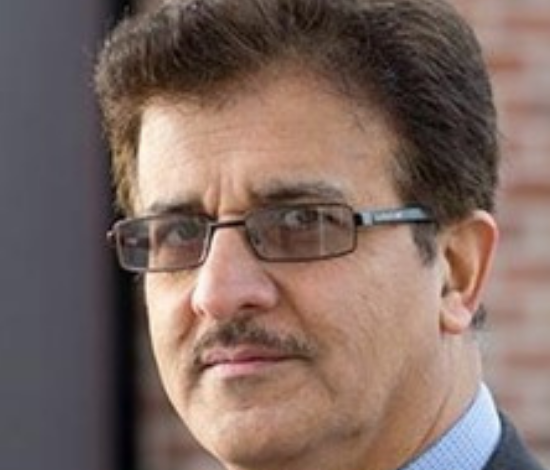
Saeid Sanei, Prof.
College of Engineering and Computer Science
Professor - Computer Science (Signal Processing & Machine Learning)
Biography
Professor Sanei, an internationally renowned scholar in the field of brain research, received his PhD from Imperial College London in 1991. He is a Fellow of the British Computer Society (FBCS) and a Fellow of IEEE (FIEEE). Returning from Singapore to the UK in 2002, he became a Lecturer at King’s College London until 2004, then held the position of Senior Lecturer at Cardiff University (UK). In 2010, he moved to the University of Surrey as Reader and Deputy Head of Department, before becoming a Professor at Nottingham Trent University in 2017. Since then, he has also been a Visiting Professor at the CSP Group, Department of Electrical and Electronics Engineering, Imperial College London and Institute of Psychiatry, Psychology & Neuroscience, King’s College London.
He has developed four undergraduate and graduate programs and taught more than 30 courses in the fields of Computer Science, Electrical Engineering, and Bioengineering. He has also served as an External Examiner for many universities at home and abroad.
Professor Sanei’s research focuses on advanced signal processing, machine learning, and cooperative sensor networks, with major applications in cognitive computing and bioengineering. He pioneered the analysis of epileptic brain responses to deep brain stimulation (DBS). He developed novel deep learning methods for detecting interictal epileptic discharges (IEDs), introducing uncertainty in data labeling into the detection model for the first time. In seminal clinical research, he demonstrated that IEDs and late responses to deep brain stimulation originate from the same epileptogenic region. He also pioneered EEG hyperscanning for brain-computer interfaces (BCIs). Professor Sanei introduced new multiscale dispersion entropy methods, including multiscale dispersion graph entropy, and contributed to the development of multi-channel, multi-axis surrogate generation techniques – particularly useful for deep neural networks that require large amounts of data.
His work has been published in five books (a sixth in progress), seven edited books, eight book chapters, and over 470 international peer-reviewed scientific articles. Professor Sanei has also organized and chaired many leading IEEE and international scientific conferences, including IEEE ICASSP 2019 in Brighton, UK.
• Adaptive Cooperative Networks
• AI and Machine Learning
• Analysis of Brain Abnormalities, Diseases, and States (with major interest in Seizure Identification)
• Brain-Computer Interfacing and Human Rehabilitation
• Computer Networking
• Digital Signal Processing including Biosignal Processing
• Internet of Things (IoT)
• Large Language Models (LLMs)
• Semantic EEG-to-Speech Transformation
• Statistical Signal Processing
• Surrogate Data Generation
• Adaptive and Nonlinear Systems (Adaptive Filters)
• Artificial Intelligence
• Bioelectronics and Biosignal Processing
• Computer Networking
• Digital Communication Systems
• Digital Control
• Digital Design
• Digital Signal Processing
• Internet of Things
• Machine Learning and Pattern Recognition
• Multimedia Computing/Signal Processing
• Speech Processing
• Statistical Signal Processing
• Wireless Communications
1. S. Sanei, A. H. Valentin, and G. Alarcon, EEG Processing and Learning for Epilepsy Identification, John Wiley & Sons, 2026, ISBN: 978-1394396764.
2. S. Sanei and J. A. Chambers, EEG Signal Processing and Machine Learning, John Wiley & Sons, 2021, ISBN-10: 978-1119386942; ISBN-13: 978-1119386940.
3. S. Sanei, D. Jarchi and A. G. Constantinides, Body Sensor Networking, Design and Algorithms, John Wiley & Sons, 2020, ISBN-10: 978-1-119-39001-5 (eBook), ISBN-13: 978-1-119-39002-2 (hardcopy).
4. S. Sanei and H. Hassani, Singular Spectrum Analysis of Biomedical Signals, CRC Press, 2015, ISBN-10: 1466589272.
5. S. Sanei, Adaptive Processing of Brain Signals, John Wiley & Sons, 2013, ISBN- 10: 0470686138.
6. S. Sanei and J. A. Chambers, EEG Signal Processing, John Wiley & Sons, 2007, (reprint in 2013) ISBN-10: 0470025816.
7. M. Ajirak, T. Adali, S. Sanei, L. Grosenick, and P. Djuric, “Exploring synergies: advancing neuroscience with machine learning corresponding,” Signal Processing, 110116, June 2025.
8. A. Falcon-Caro, J. F. Ferreira, and Saeid Sanei, “Cooperative identification of prolonged movement from EEG for BCI without feedback, IEEE Access, vol. 13, pp. 11765-11777, Jan. 2025.
9. S. Shirani, B. Abdi-Sargezeh, A. Valentin, G. Alarcon, and S. Sanei, “Do interictal epileptiform discharges and brain responses to electrical stimulation come from the same location? An advanced source localization solution,” IEEE Transactions on Biomedical Engineering, vol. 71, no. 9, pp. 2771-2780, 2024, doi: 10.1109/TBME.2024.3392603 (selected as Feature Paper).
10. Falcon-Caro, S. Shirani, J. Farriera, J. Bird, and S. Sanei, “Formulation of common spatial patterns for multitask hyperscanning BCI,” IEEE Transactions on Biomedical Engineering, Vol. 71, Issue 6, pp. 1950-1957, 2024,
11. Sam, R. Boostani, S. Hashempour, M. Taghavi, and S. Sanei, “Depression identification using EEG signals via a hybrid of LSTM and spiking neural networks,” IEEE Transactions on Neural Systems and Rehabilitation Engineering, vol. 31, pp. 4725-4737, Dec. 2023,
12. A. Zandbagleh, H. Azami, S. Mirzakouchaki, M. R. Daliri, S. Sanei and P. Premkumar, “Multiscale fluctuation dispersion entropy of EEG as a physiological biomarker of schizotypy,” IEEE Access, vol. 11, pp. 110124-110135, 2023.
13. A. Zandbagleh, S. Mirzakuchaki, M. R. Daliri, A. Sumich, J. D. Anderson and Saeid Sanei, “Graph-based analysis of EEG for schizotypy classification applying flicker Ganzfeld stimulation,” Journal of Nature Schizophrenia, vol. 9, No. 64, pp. 1-10, 2023.
14. S. Shirani, B. Abdi-Sargezeh, A. Valentin, G. Alarcon, and S. Sanei “Localization of epileptic brain responses to single-pulse electrical stimulation by developing an adaptive iterative linearly constrained minimum variance beamformer,” International Journal of Neural Systems, Vol. 33, Issue No. 10, Article No. 2350050, 2023.
15. A. Mobaien, R. Boostani, M. Mohammadi, and S. Sanei, “ERP detection based on smoothness priors” IEEE Transactions on Biomedical Engineering, 70(3), pp. 867-876, 2023.
16. H. Azami, S. Sanei, and T. K. Rajji, “Ensemble entropy: A low bias approach for data analysis”, Journal of Knowledge-Based Systems, online: vol. 28 Nov. 2022, 109876, Doi. 10.1016/j.knosys.2022.109876.
17. N. Goshtasbi, R. Boostani, and S. Sanei, “SleepFCN: A fully convolutional deep learning framework for sleep stage classification using single-channel electroencephalograms,” IEEE Transactions on Neural Systems and Rehabilitation Engineering, vol. 30, pp. 2088-2096, 2022.
18. B. Abdi-Sargezeh, A. Valentin, G. Alarcon, D. Martin-Lopez, and S. Sanei, “Sparse common feature analysis for detection of interictal epileptiform discharges from scalp EEG using concurrent intracranial-scalp recordings,” IEEE Access, vol. 10, pp. 49892-49904, 2022.
19. S. Hashemipour, R. Boostani, and S. Sanei, “Continuous scoring of depression from EEG signals via a hybrid of convolutional neural networks, IEEE Transactions on Neural Systems and Rehabilitation, vol. 30, 176-183, 2022.
20. A. Zandbagleh, S. Mirzakuchaki, M. R. Daliri, P. Premkumar, and S. Sanei, “Schizotypy assessment via evaluation of brain connectivity,” International Journal of Neural Systems, Vol. 32, No. 4 (2022) 2250013 (17 pages).
21. V. Vahidpour, A. Rastegarnia, A. Khalili, W. M. Bazzi, and S. Sanei, “Energy-efficient diffusion Kalman filtering for multi-agent networks in IoT” IEEE Internet of Things Journal, vol. 9, no. 8, 6277-6287, 2022.
22. .S. Afshar, R. Boostani, and S. Sanei, “A combinatorial deep learning structure for precise depth of anesthesia estimation from EEG Signals,” IEEE Journal of Biomedical and Health Informatics, vol. 25, issue 9, pp. 3408-3415, 2021.
23. B. Abdi-Sargezeh, A. Valentin, G. Alarcon, and S. Sanei, “Incorporating uncertainty in data labeling into automatic detection of interictal epileptiform discharges from concurrent scalp EEG via multi-way analysis,” International Journal of Neural Systems (IJNS), Vol. 31, Issue 08, Article No. 2150019, Year 2021.
24. D. Jarchi, J. Kaler, and S. Sanei, “Lameness detection in cows using hierarchical deep learning and synchrosqueezed wavelet transform,” IEEE Sensors Journal, vol. 21, Issue: 7, pp. 9349-9358, Apr. 2021.
25. A. Khalili , V. Vahidpour, A. Rastegarnia, A. Farzamnia, K. Teo Tze Kin, and S. Sanei , “Coordinate-descent adaptation over Hamiltonian multi-agent networks,” IEEE Sensors 2021 Nov 20;21(22):7732.
26. H. Giv, A. Khalili, A. Rastegarnia, and S. Sanei, “A robust adaptive estimation algorithm for Hamiltonian sensor networks,” IEEE Control Systems Letters 5 (4), 1243-1248, 2020.
27. V. Vahidpour, A. Khalili, A. Rastegarnia, W. Bazzi, and S. Sanei, “Variants of partial update augmented CLMS algorithm and their performance analysis,” IEEE Transactions on Signal Processing, vol. 68, no. 1, pp. 3146-3157, 2020.
28. M. Latifi, A. Khalili, A. Rastegarnia, and S. Sanei, “A robust scalable demand-side management based on diffusion-ADMM strategy for smart grid,” IEEE Internet of Things (IoT) Journal, vol. 7, no. 4, pp. 3363-3377, 2020.
29. M. Latifi, A. Khalili, A. Rastegarnia, W. M. Bazzi, and S. Sanei, “A self-governed online energy management and trading for smart micro/nano-grids,” IEEE Transactions on Industrial Electronics, vol. 67, issue 1, pp. 7484-7498, 2020.
30. H. Azami, S. E. Arnold, S. Sanei, Z. Chang, G. Sapiro, J. Escudero, and A. S. Gupta, “Multiscale fluctuation-based dispersion entropy and its applications to neurological diseases,” IEEE Access, vol. 7, no. 1, pp. 68718-68733, 2019.
31. A. Rastegarnia, P. Malekian, A. Khalili, W. M. Bazzi, and S. Sanei, “Tracking analysis of minimum kernel risk-sensitive loss algorithm under general non-Gaussian noise,” IEEE Transactions on Circuits and Systems II, Vol 66, no. 7, pp. 1262-1266, 2019.
32. V. Vahidpour, A. Rastegarnia, A. Khalili, and S. Sanei, “Partial diffusion Kalman filtering for distributed state estimation in multiagent networks,” IEEE Transactions on Neural Networks and Learning Systems, vol. 30, no. 12, pp. 3839 – 3846, 2019.
33. A. Akbari, M. Trocan, S. Sanei, and B. Granado, “Joint sparse learning with nonlocal and local image priors for image error concealment,” IEEE Transactions on Circuits and Systems for Video Technology, vol. 30, no. 8, pp. 2559 – 2574, 2019.
34. M. Latifi, A. Rastegarnia, A. Khalili, and S. Sanei, “Agent-based decentralized optimal charging strategy for plug-in electric vehicles” IEEE Transactions on Industrial Electronics, vol. 66, no. 5, pp. 3668-3680, 2019.
35. M. Latifi, A. Khalili, A. Rastegarnia, and S. Sanei, “A Bayesian real-time electric vehicle charging strategy for mitigating renewable energy fluctuations, IEEE Transactions on Industrial Informatics, vol. 15, no. 5, pp. 2555-2568, 2018.
36. A. Antoniades, L. Spyrou, D. Martin-Lopez, A. Valentin, G. Alarcon, S. Sanei, and C. Cheong Took, “Deep neural architectures for mapping scalp to intracranial EEG,” International Journal of Neural Systems, 28(8):1850009, 2018.
37. S. Monajemi, S. Sanei, and S.-H. Ong, “Information reliability in complex multitask networks,” Elsevier Journal of Future Generation Computer Systems, Special Issue on Measurements and Security of Complex Networks and Systems, vol. 83, pp. 485-495, 2018.
38. A. Antoniades, L. Spyrou, D. Martin-Lopez, A. Valentin, G. Alarcon, S. Sanei, and C. Cheong Took, “Detection of interictal discharges using convolutional neural networks from multichannel intracranial EEG”, IEEE Transactions Neural Systems and Rehabilitation Engineering, vol. 25, no. 12, pp. 2285-2294, 2017.
39. A. Khalili, A. Rastegarnia, and S. Sanei, “Performance analysis of incremental LMS over flat fading channels”, IEEE Transactions on Control of Network Systems, Vol. 4, Issue 3, pp. 489-498, 2017.
40. M. Latifi, A. Khalili, A. Rastegarnia, and S. Sanei, “Fully distributed demand response using adaptive diffusion Stackelberg algorithm,” IEEE Transactions on Industrial Informatics, vol. 13, no. 5, pp. 2291-2301,
41. V Vahidpour, A Rastegarnia, A Khalili, WM Bazzi, S Sanei, “Analysis of partial diffusion LMS for adaptive estimation over networks with noisy links,” IEEE Transactions on Network Science and Engineering 5 (2), 101-112, 2017.
42. S. Wang, H. L. Tang, L. I. Al Turk, Y. Hu, S. Sanei, G. M. Saleh and T. Peto, “Localising micro-aneurisms in fundus images through singular spectrum analysis,” IEEE Transactions on Biomedical Engineering, vol. 64, no. 5, pp. 990 – 1002, 2016.
43. S. Monajemi, K. Eftaxias, S.-H. Ong, and S. Sanei, “An informed multitask diffusion adaptation approach to study tremor in Parkinson’s disease,” IEEE Journal of Selected Topics in Signal Processing, vol. 10, no. 7 , pp. 1306-1314, 2016.
44. L. Spyrou, D. M. Lopez, G. Alarcon, A. Valentin, and S. Sanei, “Detection of intracranial signatures of interictal epileptiform discharges from concurrent scalp EEG,” International Journal of Neural Systems, IJNS’s Vol. 26, Issue No. 04, 2016.
45. S. Enshaeifar, S. Kouchaki, C. Cheong Took, and S. Sanei, “Quaternion singular spectrum analysis of electroencephalogram with application to sleep analysis,” IEEE Transactions on Neural Systems & Rehabilitation Engineering, Vol. 24, no. 1, pp. 57 – 67, 2016.
46. A. Khalili, A. Rastegarnia, and S. Sanei, “Quantised augmented complex least mean-square algorithm: derivation and performance,” Signal Processing, Vol. 121, Issue C, pp. 54-59, April 2016.
• 1991: PhD in Biosignal Processing and Pattern Recognition, Imperial College London, UK.
• 1987: MSc in Satellite Communication Engineering, University of Surrey, UK.
• 1985: BSc in Electronics, Isfahan University of Technology, Iran.
1. R&D bronze award for Real-time Blind Separation of Speech Signals by Singapore TBF, 2000.
2. Best Paper Award; “Brain computer interfacing in space-time-frequency domain”, 3rd BCI Workshop, Graz, Austria, Sept. 2006.
3. Best Paper Award; “A hybrid particle filtering – beamforming approach for localization of ERP sources,” Proc. Of IEEE International Conference on Acoustics, Speech and Signal Processing, ICASSP 2009, Taiwan.
4. Best Paper Award; “Fusion of Nonlinear Measures in Fronto-Normal Gait Recognition,” Proc. Of the ICCGI 2010: The Fifth International Multi-Conference on Computing in the Global Inf. Tech. Sept. 2010 – Valencia, Spain.
5. 3rd Rank Award: Signal Separation Evaluation Campaign (SiSEC 2011), third community-based blind source separation scientific evaluation campaign.
6. Distinguished Lecturer Award, International Association of Financial Risk Management, Beijing, China, 2012.
7. Best Reviewer Award; European Signal Processing Society, EURASIP, Lisbon, Sept. 2014.
8. Diploma of Honour, from SRBM (Society of Romanian Biomedical Engineering), June 2017.
9. Vision, Prestige, and Leadership Award for Innovative and Extensive Knowledge toward Bringing Excellence in Biomedical Science, 2017, Romania
10. Recognition of Major Contribution by Engineering and Physical Research Council (EPSRC) UK, Jan. 2018.
11. Recognition and Appreciation Award by the IEEE Signal Processing Society for organizing and chairing IEEE ICASSP 2019, Brighton, UK.
12. Best Paper Award by European Signal Processing Society for the paper: Distributed Beamforming for Localization of Brain Seizure Sources from Intracranial EEG Array,” Proceedings of European Signal Processing Conference, EUSIPCO 2024, Lyon, France.
13. Feature Paper award: Our paper “Do interictal epileptiform discharges and brain responses to electrical stimulation come from the same location? An advanced source localization solution, IEEE Transactions on Biomedical Engineering, vol. 71, no. 9, pp. 2771-2780, 2024, was selected as Feature Paper by IEEE TBME.
14. 2024 Hojjat Adeli Award for Outstanding Contribution to Neural Systems (plaque+$5000) for the paper “Localization of Epileptic Brain Responses to Single-Pulse Electrical Stimulation by Developing an Adaptive Iterative Linearly Constrained Minimum Variance Beamformer,” published in the International Journal of Neural Systems, IJNS, 33:10, 2023.
