

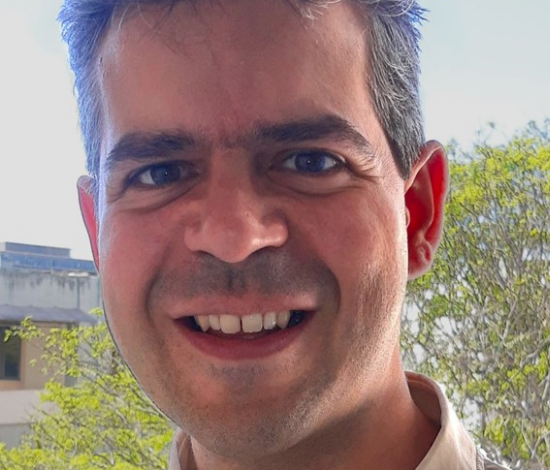
Leandro Soriano Marcolino, PhD
College of Engineering and Computer Science
Assistant Professor - Computer Science
Biography
Leandro Soriano Marcolino obtained his doctorate degree at University of Southern California (USC), advised by Milind Tambe. He has published more than 80 papers in several key conferences and journals in AI, robotics and machine learning, such as AAAI, AAMAS, IJCAI, CVPR, NeurIPS, ICRA and IROS. He received the best dissertation and the best research assistant award from the Computer Science Department at USC, had a paper nominated for best paper from the leading multi-agent conference AAMAS, and had his undergraduate work selected as the best in the nation by the Brazilian Computer Science Society.
Leandro completed his masters degree in Japan (with the highly-competitive Monbukagakusho scholarship) and his undergraduate degree in Brazil at Universidade Federal de Minas Gerais (receiving a gold medal for finishing the course with the highest grades). He has graduated 8 PhD students, which are now employed in many top institutions across the globe, such as Google, Southampton University, São Paulo University, University of California, Santa Cruz, etc.
He is a reviewer for several important venues in AI and Machine Learning, including key positions such as Area Chair for IJCAI, and senior PC member for IJCAI and AAMAS. His main expertise is on agent-based systems, encompassing multi-agent teamwork, machine learning, robotics; with emphasis on coordination and collaboration. Leandro has conducted his research in the context of a variety of domains, such as robotics, computer vision, Go, video games, social networks, bioinformatics and even architectural design. Additionally, he has published 3 literary books: one novel, one book of short stories, and one introduction to the game of Go for kids.
• Artificial Intelligence
• Machine Learning
• Agents and Multi-agent Systems
• Reinforcement Learning
• On-line Learning and On-line Planning
• Robotics
• Games
• Computer Vision
• Bioinformatics
• Artificial Intelligence
• Machine Learning
• Programming
• Algorithms
• Mathematics and Theory of Computation
1. M. Alsomali, R. Rodrigues-Filho, L. S. Marcolino, B. Porter. “An Online Incremental Learning Approach for Configuring Multi-arm Bandits Algorithms”. In Proceedings of the 27th European Conference On Artificial Intelligence (ECAI 2024), October 2024.
2. M. A. do Carmo Alves, A. Varma, L. S. Marcolino, Y. Elkhatib. “It Is Among Us: Identifying Adversaries in Ad-hoc Domains Using Q-valued Bayesian Estimations”. In Proceedings of the 23rd International Conference on Autonomous Agents and Multiagent Systems (AAMAS 2024), May 2024.
3. R. Mu, L. S. Marcolino, Q. Ni, W. Ruan. “Enhancing robustness in video recognition models: Sparse adversarial attacks and beyond”. In Neural Networks, vol. 171, March 2024.
4. R. Mu, L. S. Marcolino, T. Zhang, Y. Zhang, X. Huang, W. Ruan. “ReCePS: Reward Certification for Policy Smoothed Reinforcement Learning”. In Proceedings of the 38th AAAI Conference on Artificial Intelligence (AAAI 24): Safe, Robust and Responsible AI (SRRAI) Special Track, February 2024.
5. A. Kerim, W. S. Ramos, L. S. Marcolino, E. R. Nascimento, R. Jiang. “Leveraging Synthetic Data to Learn Video Stabilization Under Adverse Conditions”. In Proceedings of the IEEE/CVF Winter Conference on Applications of Computer Vision (WACV 2024), January 2024.
6. Y. T. Passos, X. Duquesne, L. S. Marcolino. “Congestion control algorithms for robotic swarms with a common target based on the throughput of the target area”. In Robotics and Autonomous Systems, vol. 159, 2023.
7. M. A. C. Alves, A. Varma, Y. Elkathib, L. S. Marcolino. “Information-guided Planning: An Online Approach for Partially Observable Problems”. In Proceedings of the 37th Conference on Neural Information Processing Systems (NeurIPS 2023), December 2023.
8. E. Alharbi, L. S. Marcolino, A. Gouglidis, Q. Ni. “Robust Federated Learning Method against Data and Model Poisoning Attacks with Heterogeneous Data Distribution”. In Proceedings of the 26th European Conference on Artificial Intelligence (ECAI 2023), September 2023.
9. R. Mu, W. Ruan, L. S. Marcolino, Q. Ni. “3DVerifier: efficient robustness verification for 3D point cloud models”. In Machine Learning, 2022.
10. A. Kerim, F. Chamone, W. S. Ramos, L. S. Marcolino, E. R. Nascimento, R. Jiang. “Semantic Segmentation under Adverse Conditions: A Weather and Nighttime-aware Synthetic Data-based Approach”. In Proceedings of the 33rd British Machine Vision Conference (BMVC 2022), November 2022.
11. E. S. Yourdshahi, M. A. C. Alves, A. Varma, L. S. Marcolino, J. Ueyama, P. Angelov. “On-line estimators for ad-hoc task execution: learning types and parameters of teammates for effective teamwork”. In Autonomous Agents and Multi-Agent Systems, vol. 36, no. 45, August 2022.
12. Y. T. Passos, X. Duquesne, L. S. Marcolino, “On the Throughput of the Common Target Area for Robotic Swarm Strategies”, Mathematics, vol. 10, no. 14, 2482, July 2022.
13. W. Ramos , M. Silva, E. Araújo, V. Moura, K. Oliveira, L. S. Marcolino, and E. R. Nascimento. “Text-driven video acceleration: A weakly-supervised reinforcement learning method”. In the IEEE Transactions on Pattern Analysis and Machine Intelligence (TPAMI), March 2022.
14. R. Mu, W. Ruan, L. S. Marcolino, Q. Ni. “Sparse Adversarial Video Attacks with Spatial Transformations”. In Proceedings of the 32nd British Machine Vision Conference (BMVC 2021), November 2021.
15. L. Pelcner, S. Li, M. A. C. Alves, L. S. Marcolino, A. Collins. “Real-time Learning and Planning in Environments with Swarms: A Hierarchical and a Parameter-based Simulation Approach”. In Proceedings of the 19th International Conference on Autonomous Agents and Multiagent Systems (AAMAS 2020), May 2020.
16. W. De Souza Ramos, M. M. Silva, E. R. Araujo, L. S. Marcolino, E. R. Nascimento. “Straight to the Point: Fast-forwarding Videos via Reinforcement Learning Using Textual Data”. In Proceedings of the 2020 IEEE Conference on Computer Vision and Pattern Recognition (CVPR 2020), June 2020.
• 2016: PhD in Computer Science, University of Southern California, Los Angeles, USA.
• 2011: Masters in Systems Information Science, Future University – Hakodate, Hokkaido, Japan.
• 2008: Bachelor in Computer Science, Federal University of Minas Gerais, Belo Horizonte, Minas Gerais, Brazil.
• 2024: Best Doctoral Thesis Award, for his student Washington L. S. Ramos, from SIBGRAPI 2024 (Conference on Graphics, Patterns and Images, leading annual event in Latin America organised by the Brazilian Computer Society)
• 2023: Quality Champion Reviewer Award, from the European Conference on Artificial Intelligence (ECAI) 2023.
• 2018: Best Program Committee Award, from the International Conference on Principles and Practice of Multi-Agent Systems (PRIMA) 2018.
• 2016: Best Dissertation, from the Computer Science Department, University of Southern California (USC).
• 2015: Top innovations that improved the world, listed at Mashable.com, as one of the top 26 incredible innovations that improved the world.
• 2015: Best Research Assistant, from the Computer Science Department, University of Southern California (USC).
• 2011: Best paper nominee, 4 out of 127 full papers and 575 submissions, at the Tenth International Conference on Autonomous Agents and Multi-Agent Systems (AAMAS 2011).
• 2009: Best paper, Brazilian national competition of undergraduate works in Computer Science, by the Brazilian Computer Science Society
