New horizons in bioelectronics: healthcare and beyond
September 22, 2025


Imagine a paralyzed individual one day commanding a robotic arm with their thoughts using a simple skin-worn patch.
This scenario isn’t here yet, but research on organic electrochemical transistors (OECTs), presented at Horizons 2025 hosted by VinUniversity Center for Environmental Intelligence (CEI), shows how we’re moving closer.
OECTs in a nutshell: Think of them as ultra-sensitive amplifiers for the body: soft, flexible devices that translate biological signals into electrical ones.
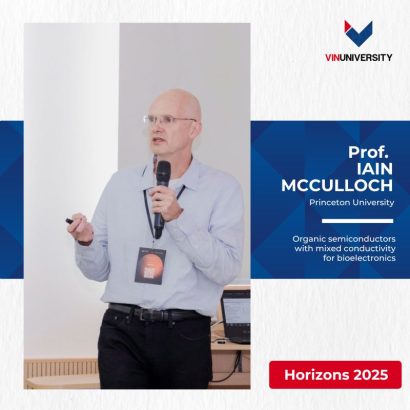
The breakthrough: Prof. Iain McCulloch (Princeton University) and his team developed new organic polymers designed like nano-sized molecular grids (2D COFs). With carefully engineered porosity and a balanced hydrophobic–hydrophilic profile, these materials let ions flow easily while keeping the structure stable.
The result: devices that combine sensitivity, durability, and ultra-low operating voltage.
Why it matters: Though still at an early stage, this research lays important groundwork for the future of bioelectronics, opening pathways toward smarter diagnostics and the foundations of neural interfaces.
By bringing world-leading scientists together in Hanoi, Horizons 2025 at VinUniversity provides a global platform where ideas like these can spark collaborations that may shape the future of healthcare and beyond.
What possibilities do you see for healthcare and brain–machine connections?