Automation and Robotics in Manufacturing: Career Path
February 25, 2026


The factory of the past was defined by steam, sweat, and repetitive manual labor. The factory of 2025 is defined by code, sensors, and silicon. As the digital foundations of Industry 4.0 continue to mature, and as conversations shift toward the emerging, human-centric concepts of Industry 5.0, the convergence of automation and robotics in manufacturing has created one of the most dynamic career landscapes for Computer Science professionals.
It is a common misconception that manufacturing careers are solely for mechanical engineers. In reality, modern automated systems are software-defined. From the algorithmic logic that guides a robotic arm to the machine learning models predicting equipment failure, the heart of modern production is computer science.
This guide explores the technical depth of this field, the technologies powering the next generation of factories, and how elite educational pathways at VinUniversity with a curriculum validated by Cornell University are preparing students to lead this industrial revolution.
To understand the career trajectory in this field, one must first distinguish between traditional mechanization and modern computational automation. The field has moved far beyond simple machinery to complex, decision-making ecosystems.
Historically, industrial automation referred to “hard automation” machines designed to perform a single task repeatedly with high precision but zero flexibility. If the product design changed, the entire assembly line had to be physically retooled. This was the era of hardware dominance.
Today, automation and robotics in manufacturing have shifted toward “soft automation” or intelligent systems. These are robotic units driven by complex software that can be reprogrammed to handle different tasks, recognize different objects, and adapt to environmental changes with a high degree of autonomy. However, rather than operating in complete isolation (“without human intervention”), the current industry standard relies on human-supervised autonomy and human-in-the-loop models. In this symbiotic setup, algorithms execute complex tactics while humans provide high-level strategic oversight and handle edge cases.
This shift from rigid hardware to flexible intelligence fundamentally changes the skill sets required in the industry. It is no longer enough to understand mechanics; one must understand the computational brain that drives the machine, leading to a new definition of automation rooted deeply in computer science.
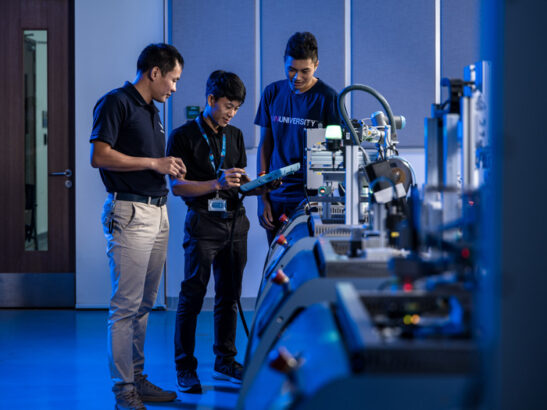
Automation and robotics in manufacturing have shifted toward “soft automation” or intelligent systems
In the modern context, a robot is simply a peripheral device attached to a computer. Computer Science defines automation not as the movement of parts but as the flow of data and logic.
By redefining automation as a data-driven discipline, we open the door to advanced computational applications. However, definitions are only theoretical until they are deployed; to grasp the true career potential, we must examine how these software concepts are rigorously implemented on the factory floor.
The application of automation and robotics in manufacturing is where abstract code meets physical reality. For Computer Science graduates, this sector offers unique challenges involving real-time constraints and safety-critical systems.
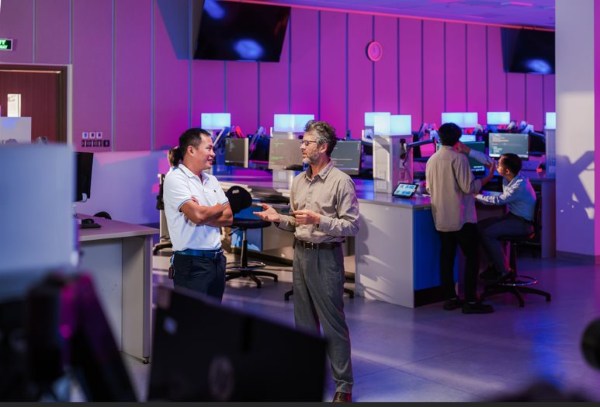
In a modern factory, software is the central nervous system. It exists in layers, from the low-level firmware controlling a servo motor to the high-level Enterprise Resource Planning (ERP) systems managing global supply chains.
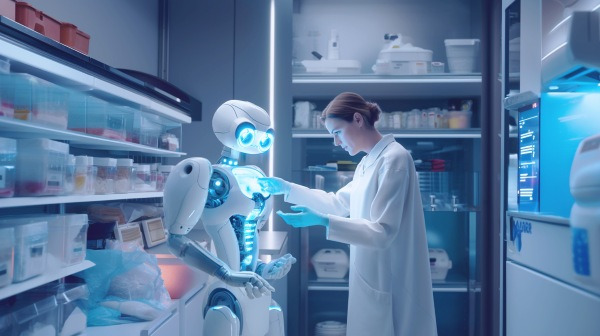
In a modern factory, software is the central nervous system
While these high-level algorithms manage the overall logic, the factory floor demands a specific type of performance that standard software often lacks. The critical differentiator in manufacturing is the non-negotiable requirement for speed and precision, known technically as real-time computing.
In web development, a 500-millisecond delay is an annoyance. In automation and robotics in manufacturing, a 500-millisecond delay can cause a machine to crush a product or injure a worker.
Real-time computing ensures that the system responds to an input within a strict time constraint.
Mastering real-time constraints is a foundational skill but the industry is constantly pushing for higher levels of autonomy. To achieve this, engineers are now integrating cutting-edge technologies that allow factories to not just follow instructions but to think and learn for themselves.
The career path in manufacturing automation is increasingly converging with the path of an AI engineer or data scientist. The technologies driving the sector are at the bleeding edge of computer science research.
Artificial Intelligence (AI) is the primary driver of the “Smart Factory.” It transforms automation and robotics in manufacturing from reactive to predictive.
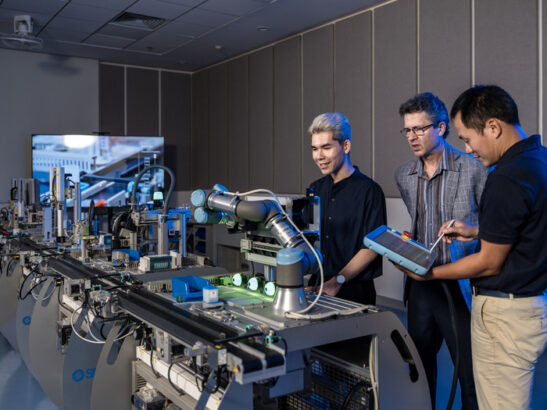
Artificial Intelligence (AI) is the primary driver of the “Smart Factory”
AI provides the brainpower for individual machines but a factory is a collective organism. To function effectively, these intelligent islands must be connected into a cohesive whole, requiring sophisticated data processing and coordination architectures.
The Industrial Internet of Things (IIoT) generates massive amounts of data. Processing this data requires robust distributed systems.
The technological complexity is immense but businesses do not invest in these systems for the sake of novelty. They do so for tangible outcomes. Understanding the strategic advantages of these technologies is crucial for any professional looking to advance their career in this sector.
Why are global giants pouring billions into automation and robotics in manufacturing? The answer lies in the “Iron Triangle” of production: Speed, Cost, and Quality.
Humans are creative but inconsistent. Robots are uncreative but perfectly consistent.
Efficiency drives profit but in a volatile global market, resilience is equally important. The modern automated factory is designed to weather supply chain shocks and shifting consumer demands through the inherent flexibility of software.
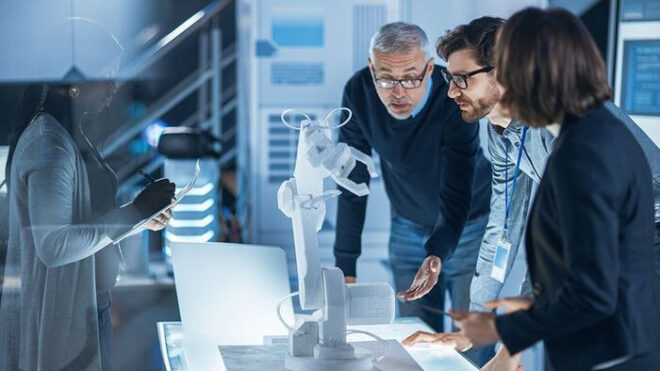
Robots are uncreative but perfectly consistent
The rigid assembly lines of the 20th century were fragile. Today’s software-driven approach offers resilience.
The impact of these systems is profound but they do not build themselves. The industry is facing a severe talent shortage not of machine operators but of the computer scientists and researchers capable of designing these architectures. This brings us to the educational pathways necessary to enter this elite field.
To thrive in this career, self-study is rarely enough. You need a structured academic environment that blends deep theoretical computer science with heavy industrial application. VinUniversity offers precisely this ecosystem.
For undergraduates, the journey begins with a curriculum that treats manufacturing as a computational challenge.
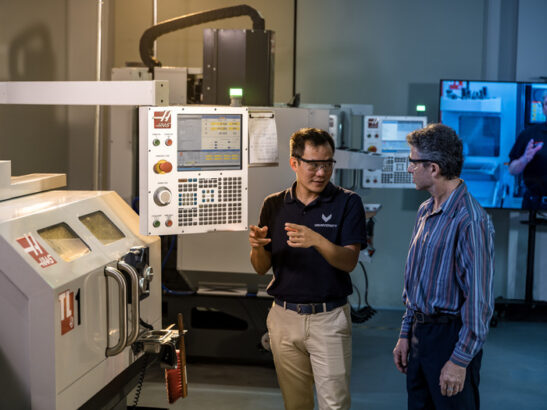
For undergraduates, the journey begins with a curriculum that treats manufacturing as a computational challenge
A strong bachelor’s degree creates a capable engineer but the frontier of automation requires researchers who can invent new paradigms. For those aiming to lead the industry or enter high-level R&D roles, VinUniversity offers a seamless pathway to advanced doctoral study.
For roles such as Principal Robotics Engineer or Chief AI Officer, a PhD is often the unspoken prerequisite.
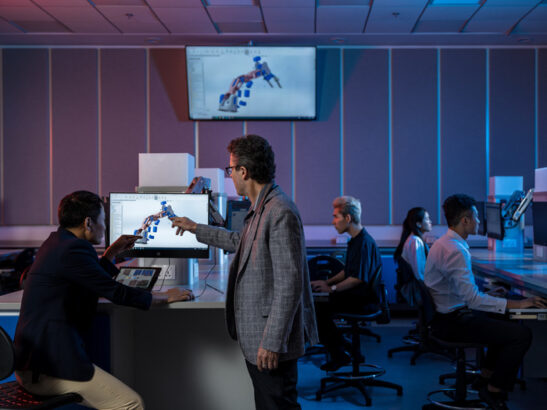
For roles such as Principal Robotics Engineer or Chief AI Officer, a PhD is often the unspoken prerequisite
So, what is the career path for automation and robotics in manufacturing? It is no longer a path of grease and gears but one of algorithms, data, and intelligent systems. It is a career for the architects of the future, those who can write the code that powers the physical economy.
Whether you are a student exploring your options or a professional looking to pivot, the opportunities in this sector are limitless. However, success requires a foundation built on rigorous computer science principles and real-world industrial exposure. Explore the Computer Science programs at VinUniversity today to secure your place in the future of technology: https://vinuni.edu.vn/